"Who is this that looks forth like the dawn, fair as the moon, bright as the sun, terrible as an army with banners?"
Showing posts with label Benedict. Show all posts

Tuesday, July 2, 2013

Thursday, July 2, 1863. Darkness came on and the battle ceased with the Sixteenth in the front line.


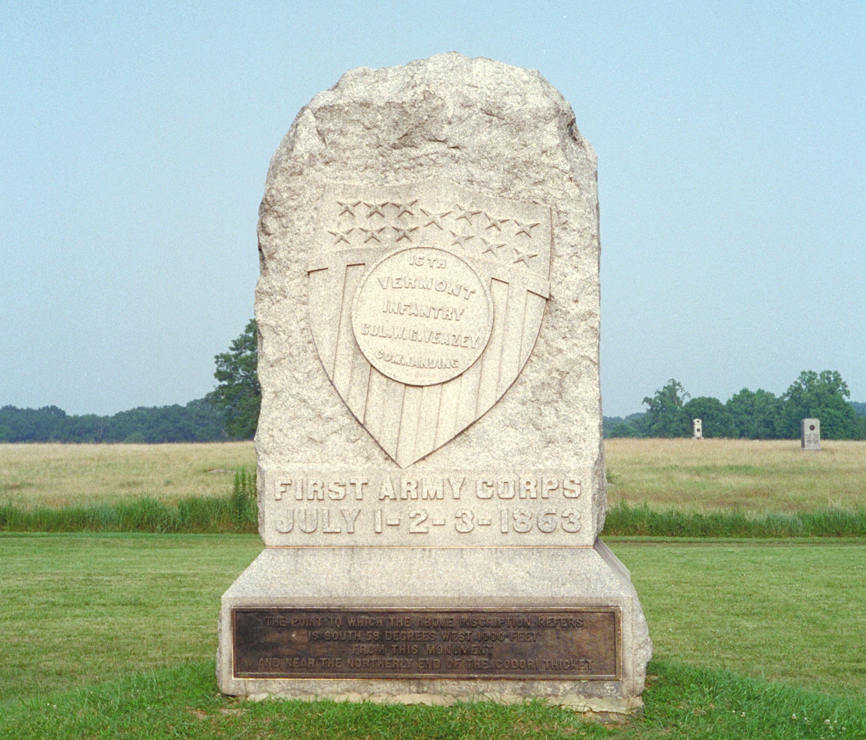
16th
Vermont
Infantry,
Colonel W. G. Veazey
commanding
First Army Corps
July 1-2-3-1863

Participated near this point in action of July 2nd
Picketed this line that night - held same as skirmishers until
attacked by Pickett's Division July 3rd.

"Camp near Gettysburg Pa
Thursday July 2nd 1863
 
Dear Wife
                        I will try and write you a few lines this morning not knowing whether it will ever reach you We have been on the march now for a week and got here last night. There was fighting here yesterday and as the rebels are near here there will probably be fighting untill they retreat or are conquered. Our Regt is now drawn up in line of battle and skirmishing is going on in front of us.

. . . You must excuse this as there is so much noise and excitement that it is almost impossible for me to write. It is a grand sight to see so large an army as we have here and more are coming every minute. We are well prepared to meet the rascals and I hope that none of them will escape. I have done faithfully my duty so far and I shall not back out now, and / I hope it will never be said of me that I did not do my duty. With much love and trusting in god for the best I am your loving Husband" ~ Letter from Corp. Francis Long, 16th, Rgmt., Company E

On the morning of the second day the regiment was moved to the rear of Cemetery Hill, and remained there in column, closed in mass (except Company B, Captain Armes, which was moved forward to the skirmish line at 4.30 p. m.), until about 5 p. m., when it was moved to the left about 100 rods, and forward to the crest of the hill, and there deployed in support of the batteries engaged. In this movement the regiment was under a severe fire, and several men were killed and wounded. Later still it was moved farther to the left and forward, and when the battle closed it occupied the front line of battle. Soon after dark I was detailed as general field officer of the day, and the whole regiment was detailed for picket duty. ~ Report of Col. Wheelock G. Veazey, Sixteenth Vermont Infantry. Headquarters Sixteenth Vermont Volunteers, Camp at Berlin, Md., July 17, 1863.
                                                                                              
"Before light we were called up and order marchers we sent out to find the 15th. They soon commenced firing and the Rebels picket. We layed there till about noon, when we were ordered to go and support a Battery around on the right. We went around and waited until about 4 o’clock before the Battery commenced, the shells began to come so near we were moved up under the brow of a small hill close to our own Battery. The artillery had been at work about a hour when Colonel Veazy told that the rebels were advancing to take the Battery. About that time they began to shell us in the rear, they came thick and close to us        the rear.
The men began to drop from other Regiments a shall burst over our Regt. a piece hit me in the breast. I was laying on my back, but had a Rebels blanket, folded up and laying across my breast, so it didn’t hurt me much.
We layed there about a hour when we went to the left to support another Battery. We marched out under heavy fire, a good many of the boys fell. We stayed at the battery about ten minutes when we were ordered still further to the left. The Rebels were advancing with a heavy force. We got up and started, The boys kept a dropping, and so it went till dark.
Then the 16th were sent to the front on Picket about 8 o’clock,  they commenced carrying off dead on both sides, the rebels were clear down to where I was, it was a awful sight to see them and hear them take on. They got off when they could through the night, but it was a small portion of what there was on the ground. " ~  Journal of Floyd Hawkins, 16th Rgmt.,  Sgt, Company H.

Thursday, July 2, 1863: Battle began at 5 PM & continued until dark. We were not engaged but lay under severe artillery fire supporting batteries - lost about 10 men. Occupied the front line when the battle closed. Whole Reg. put on picket. Am Div. field officer of Day."   From the Diary of Wheelock G. Veazey, Colonel, 16th Vermont Regiment.(VHS), in David Cross, Wheelock Veazey, (Rutland Historical Society, 1995)

"During the forenoon, company B, Captain Arms was send forward to re-enforce the skirmish line, and there rendered splendid service. This company was taken into position by Captain Foster of company C, who was then on General Stannard's staff, and was wounded in discharging this duty.

"The main battles of July 2 were fought on the right and left flanks of the Union line. Near the close of the battle on the left the Sixteenth, with the rest of the brigade, was moved about one-half mile to the left along Cemetery Ridge to re-enforce our badly shattered lines. In this movement it was under terrific artillery fire, one shell hitting two men and killing them instantly. The regiment was finally halted in support of a battery and just in season to receive and repel a heavy charge of infantry. Darkness soon came on and the battle ceased with the Sixteenth in the front line." 
~Russell and Emery, 16th Vermont Infantry Regimental History

"The Sixteenth moved left in front, down the Taneytown road a short distance, and then into the field and along the crest till it reached the position of the Second Corps' batteries, receiving as it moved a cannon-shot—the first that entered its ranks—which knocked down a file of men, killing two of them. The smoke enveloped that part of the ridge, but it could be seen that a battery near there was without support, and a line of the enemy was both seen and heard advancing upon the guns with loud shouting. The Sixteenth deployed in rear of the battery; the enemy, disconcerted by the appearance of this fresh line, fell back; and the Sixteenth supported the battery till dark, when the regiment was moved to the left and forward into the front line in that part of the field." ~ 2 George Grenville Benedict, Vermont in the Civil War 455-56(Burlington Vt 1888). 

"An order came for me to take my Company down to the line of the skirmishers at the centre of our line, as a portion of them had been driven in. I started off with Capt. Foster of Co. C, of our Regiment, who was to bring intelligence to the General as to the condition of the line. I had proceeded but a short distance when the bullets began to whistle around me, but not a boy in my Company but that marched and obeyed my orders as well as they could at an ordinary drill.

"On arriving at the point where I was to support the skirmishers, I found that they were all killed or wounded but four, and they had returned leaving the rebels in possession of the line, who had five men to my one, and sharpshooters at that. They had concealed themselves so as to have a cross fire into the road where I had to lead my boys.They saw us coming and were all ready to pour into us; but seeing that matters were at a focus, I made a move and came into line in the gutter at the road side, and instantly gave an order to fall down on the ground, which was done just in time to save the lives of most of my Company, for as we fell to the ground they fired a terrible shower of balls just where we had stood, which passed harmless over our heads as we lay in the muddy ditch, with the exception of one that passed through the leg of Capt. Foster as we stood side by side.

"Afterwards I ordered the boys up and to go on. Every one went with a will, and the line was soon in our hands where we staid skirmishing between the two armies until the next forenoon. 

"During this time I had the following boys wounded. 3rd Ser'gt Jason Mann of Guilford shot in the head; will recover. Corporal D. B. Stedman of West Brattleboro, shot in the thigh; will recover. Private John M. Joy of Brattleboro badly wounded in the hips, and Surgeon thinks he will recover. ~ Captain Robert G Arms. Co. B, 16th Regt, letter of July 5, 1863

 "Soon after this Colonel Veazey was detailed to take the regiment with others and establish a picket line across the battlefield of that afternoon. The battle had been fought back and forth over this ground and it was literally covered with dead and wounded men, among whom the Sixteenth were deployed to watch the enemy while our army was resisting for a renewal of the awful conflict in the morning. No regiment ever had a more trying night on picket duty. It was not relieved in the morning, but the men held the same position as skirmishers throughout the forenoon and until the final assault." ~Russell and Emery, 16th Vermont Infantry Regimental History

"The next morning [July 2] our brigade consisting of the 13th, 14th, and 16th Regiment - the other two being at Westminster, MD - 20 miles southeast guarding the corps teams prepared for action. We were in position all the morning until about 4 o’clock when the rebels opened their batteries, ones having been playing since noon. Within five minutes thereafter a shell fell within (six feet near my) horse exploded without doing major damage. Soon the field officers dismounted and our brigade advanced to support our batteries. We were then in rear of the crest on which they were placed and there so protected that not a man was hit or hurt although their shells passed just above our heads and exploded from a few feet to one or two hundred yards beyond us. This music was not at all agreeable.

"Just before sundown we were advanced up another hill a little to the left and deployed in line amid the bursting of hundreds of shells. One came through the ranks about four feet to my right killing two men, one or two others were wounded. Up the hill we went and when on top the firing in that section had nearly ceased. We were near the center and not in the advance line there had been fighting on very ground where we were and two of our batteries had been taken and retaken. Our left had advanced and drove the rebels and they in turn had repulsed our advance with masked batteries and driven us back.

"Between the rebels and us was depressing basin through which ran a ravine well protected by brush and rocks. I was made officer of the picket and then went out and placed three companies as pickets there in two as support and the balance of the regiment left behind a clump of small trees as a reserve. I was on the line all night.

"After taking care that my line was right, I looked around and found this ravine full of dead and wounded soldiers about two rebs to one Union. Stretchers and ambulances were running all night but by morning nearly all had been removed. Between Union and rebel picket lines, parties of both were by a tacit understanding engaged in hunting up their dead and wounded comrades and friends without molestation." 
~ Lt. Col. Charles Cummings, Sixteenth Regiment, Letters July 6, 1863. VHS.


"After nightfall of Thursday Colonel Veazey was detailed as division field-officer of the day, and taking the Sixteenth Vermont regiment and a detail from the brigade on the right, posted a picket line along the front, from the right of Codori's house on the Emmittsburg road through the low grown to the left, till it joined the picket line of the Fifth Corps. Three companies were deployed on the picket line, and the remainder of the regiment lay as picket reserve. “It was,” says Colonel Veazey,
 “the saddest night on picket that I ever passed. The line ran across the field that had been fought over the day before, and the dead and wounded of the two armies, lying side by side, thickly strewed the ground. The mingled imprecations and prayers of the wounded, and supplications for help, were heart-rending. The stretcher bearers of both armies were allowed to pass back and forth through the picket lines, but scores of wounded men died around us in the gloom, before any one could bring relief or receive their dying messages.” "
~ 2 George Grenville Benedict, Vermont in the Civil War 459 (Burlington Vt 1888). 

Sunday, June 23, 2013

Tuesday, June 23, 1863. Wondering where we are going.

On the 23d the Second Vermont brigade is attached to the First corps of the Army of the Potomac under General Reynolds. ~ Russell and Emery, 16th Vermont Infantry Regimental History

Disposition of Stannard's troops June 23, 1863
( See Stannard's Route to Edwards's Ferry)

"Tuesday morning one half past seven Oclock.   Co. A is out on picket to day. The boys are all as well as usual this morning. We expect to Start for home next Sauterday if nothing new turns up. J.H. Hammond to the folks at home, one & all" ~ Jabez Hammond, West Windsor, Co. A, 12th Regt Letter No. 44, June 22, 1863

"Tuesday 23rd. Co. Drill. Right wing out on picket this A.M. No Battalion Drill, but Dress Parade as usual in eve. As my gun was very dirty & much rusted, I spent the P.M. in cleaning it. Also played Whist considerable, during the day & evening." ~ Diary of Horace Barlow (UVM), 133, Horace Barlow, Pvt., Co. C, 12th Regiment

"June 23. To-day orders have been received to be ready to march at a moment's notice, supplied with ten days' rations, which clearly shows that a long march is expected." ~ John C. Williams, Corporal, Co. B, 14th Regiment, Life in Camp 131 (1864)

"June 23, 1863. Received orders to be ready to move. I hope we will not go. Nothing new in camp to-day only all are wondering where we are going." ~ Diary of Frederick L. Reed, Orderly Sergt., Co.. D, 14th Regt., (Memorial Exercises, Castleton VT 1885, p 57-59) 

"On the 23d of June General Stannard received notice that his brigade had been attached to the Third division of the First Army Corps; that it was to hold the line of the Occoquan till the main army had passed, and then was to follow the corps and join it if possible before the great battle which was expected." ~ Benedict, Army Life in Virginia, letter to Free PressJuly 4, 1863

Lieut. Colonel Grout, commanding the four companies of the Fifteenth stationed at Catlett's, which was now the extreme southern infantry outpost on that line, was informed by General Buford, commanding the First division of the cavalry corps, then in camp within sight of Catlett's and forming the rear guard of the army, that he should move to the north that night; that the enemy was in force in his immediate front and undoubtedly follow him; and that it would not do for Grout to remain after he left. ... A car was hastily constructed by Captain Blake from some lumber and a set of car-trucks found by the side of the track. A rope was attached to the front of the car, to draw it by hand; another rope behind served the purpose of a brake. The tents and baggage were loaded, and the battalion started for Bristoe's, followed by Buford, who burned his forage and supplies, to prevent their falling into the hands of the enemy, and marched away by the light of the conflagration. A colored woman with a baby three hours old had a place on Grout's car, and a crowd of over a thousand Negroes, men, women and children, accompanied the battalion. The party joined the rest of the regiment at Bristoe's that night; and next day the regiment joined the rest of the brigade at Union Mills.   ~ 2 George Grenville Benedict, Vermont in the Civil War 438 (Burlington Vt 1888). 


Thursday, May 30, 2013

Saturday, May 30, 1863. Mosby burns a supply train


"Dear Parents: When we are moving about the time flies away so rapidly that we can scarcely keep track of the rapidly flying weeks. Nine months ago yesterday - August 29th- we went to Ludlow and organized our company. Therefore according to law and order our time was out yesterday, but it seems we must stay a while longer. Well we are good for it. If we don't see any harder times than we have seen thus far. 


"Immediately after arriving here we went to work to get us some boards and build us some first class summer houses. Indeed we have got the best quarters now that we have ever had, considering the season of the year, though they would not be so good for winter use. The table that our cooks use for giving out rations etc. was once the counter to an old store, and there is one or two shanties built entirely of green window blinds and several composed of good panel doors, painted and grained, which makes them all the better for soldiers' use. 

"We do not expect to stay here more than a fortnight anyhow. We will then either go back to Union Mills or else got to Occoquan where the 13th now is. They say that 'tis a splendid country down there so that if we do have to march down we will get partly paid for our travel. The grass is up now about as high as it usually is in Vt. at the 20th of June or 1st of July, and the clover has been in blossom this long time.

"Give my thanks to Dr. Scott for a copy of the Bellows Falls Times sent to me, and tell little Charlie that the "drummers" are out now trying to learn to drum as well as he can. ... 

"Uncle Joe is at Catlett with his company. You will remember that Popes wagon Train was surprised and burned there last August by Stuarts Cavalry and many of his papers captured. Companies E, H, C, and D and F are here and B, I, and N, at Catlett, and A and G at Manassas Junction." ~ Hezron G. Day, pvt., Company C, Sixteenth Regiment, Letter of May 30, 1863


While private Day is at Bristoe writing home, a unit of the 15th Vt. is detailed to guard a supply train carrying forage to Kelly's Ford on the Rappahannock:
"On the 30th of May a supply train of ten cars loaded with forage for the cavalry at Rappahannock Station left Alexandria. At Union Mills it took on a train guard of twenty-five men, detailed from the Fifteenth regiment under command of Lieutenant Hartshorn of company E of that regiment. Chaplain Brastow of the Twelfth accompanied the train as a passenger.
 "In the neighborhood of Catlett's Station, Major Mosby, with 50 or 60 men, was lying in wait for the train. He had obtained from General Stuart a mountain howitzer to assist his operations against the railroad trains, and, proud as a boy with a new top, he took it to a favorable spot, put it in position behind a screen of bushes about a hundred yards from the track, removed a rail sufficiently to derail the train, and taking his men under cover, awaited the train. It approached at a good rate of speed, ran off from the track and came to a halt. Mosby's first shell crashed through a car.
"His second shot went through the boiler of the locomotive. The engineer, train-men and guard waited for no more; the latter fired a few shots, one of which killed one of Mosby's horses; and springing from the cars, made their escape into the woods near by. Mosby's men at once surrounded the train, pillaged a car loaded with sutlers' supplies, and setting fire to the hay in the rest, destroyed the train and started back for the mountains."
 ~ 2 George Grenville Benedict, Vermont in the Civil War 436-37 (Burlington Vt 1888).

Lt. Col Cummings at Catlett's Station heard the firing and saw the train burn:
 I heard the firing, saw the train burn, at late the smoke and suspected mischief, but as my duties were here I could not go away and going could have done no good. If the rebs had come this way they would have met wit a warm reception. With 25 men I could have charged upon the gun and captured it and all the men who did not run. Mosby is a darling brave fellow indeed

~ Charles Cummings, letter of June 1, 1863 


The news spread to the 13th:

"Captain Thatcher returned on the 30th from Union Mills where he had been attending a court martial hearing, and reported that the Rebel guerilla Mosby with a large force had captured a supply train at Catletts Station about fifteen miles south of Fairfax Station on the Orange and Alexandria Railroad, consisting of ten cars of forage, a quantity of soft bread and Sutler's supplies had taken what they wanted and destroyed the rest, and were on their way east and might be expected at our camp any hour, and he had hastened back to camp to bring the news.

Back at Union Mills, Pvt. Barlow celebrates a birthday and at Occoquan Lt. Palmer experiences a peaceful night:

"Saturday May 30th 1863. My Birthday & the first one I have ever spent away from home. To-day completes my 21st year & brings me to my majority. Five weeks more, if my life is spared, & I hope to see Parents, friends & home. Tho' not especially tired or weary of my service, yet it is not a congenial one, by any means, & there is joy in the thought of home, sweet home. As we were all here, yesterday & I feared some one might be away to-day, I procured a few things in the eatable line, to answer for my birthday. Drills as usual to-day. Charles Thacher still quite sick. Cleaned my gun in P.M." ~ Diary of Horace Barlow (UVM), 123-4, Horace Barlow, Pvt., Co. C, 12th Regiment

"May 30. On pickets. The night is really splendid. The blue bay of Occoquan, many feet below us, gives back the shining moon and stars, the air not uncomfortable hot, and just wind enough to stir the luxuriant foliage of oaks near our post. Then there is the noise of the river to the right of us, (here it empties itself into the bay,) dashing against huge rocks; of the whippoorwill, singing its own name, by turns, all night, and often imitated by the soldiers; and of yelping curs, and now and then, loud baying, barking blood-hounds, disturbed in their kennels."  ~ Lt. Edwin Palmer, 13th Regiment, The Second Brigade: or, Camp Life, By a Volunteer (1864)

Sunday, May 26, 2013

May 26, 1863. Praise from Abercrombie.

Gen. Abercrombie
"26th. Gen. Abercrombie reviewed the 15th and 16th regiments. He praised them very highly. Said he never saw regulars do better in the manual of arms." ~ Diary of Oliver A. Browne, Co. K, 15th Regiment

"Yesterday there was a review of 15th and 16th regiments by General Abercrombie who said of the manual of arms as executed by the 16th regiment that he had never seen it excelled by regulars and had supposed it impossible of volunteers.” ~  Lt. Col Charles Cummings, 16th Reg, letter  May 26, 1863


"The Fifteenth and Sixteenth, Colonels Proctor and Veazey, were reviewed here ... by Gen. Abercrombie, commanding the division, who expressed surprise and gratification at their fine discipline and appearance. The following order is official testimony to this:


Headquarters Second Brigade,
Abercrombie's Division,
Union Mills, Va., May 26th, 1863
Special Order No. 19. 
The General Commanding desires to express to the regiments inspected to-day his congratulations on their soldierlike appearance, and to convey to them the approbation of the Division General.
Gen. Abercrombie speaks in high terms of the Review and Inspection, especially of the manner in which both regiments passed through the manual of arms, and noticed with pleasure the attention that has been paid to drill and discipline by both officers and men.
By order of Brig. Gen. G. J. Stannard,
Wm. H. Hill, A. A. G.
~ Lieut. G.G. Benedict, Company C, 12th Regiment, Letter to the Free Press of June 15, 1863 in Army Life in Virginia.


"Tuesday 26th. Drilled two hours in A.M. & then as the Capt called for Volunteers for a scout, we went out S.W. about 25 in No. We scouted about some woods & clearings near, & in the mean time had a pig hunt & killed three. Finding no enemy, we returned before dinner. 

"At night at the "Block House". Stood 3 hours & afterwards had an alarm, caused by the passage by of about 100 of the 2nd Penn Cavalry." ~ Diary of Horace Barlow(UVM), 122, Horace Barlow, Pvt., Co. C, 12th Regiment


"May 26. There was great expectations in camp last night, that we should have fun before morning. It was ascertained yesterday, that a force of rebel cavalry was within our lines, and might possibly pay us a visit. Accordingly, preparations were made for the expected attack. The line was formed, arms inspected, new rifle pits were dug, roads were blockaded, masked batteries constructed, and everything in readiness for a brush, but no engagement took place, the "rebs" making their escape through some other part of the line. A sudden change in the weather to-day, very cold." ~ John C. Williams, Corporal, Co. B, 14th Regiment, Life in Camp 121 (1864)

"This morning at 7:30 our regiment goes down the railroad to relieve the 12th. Two companies will be left at Manassas Junction. 5 at Bristow’s and three at Catlett’s Station, towards Warrenton Junction."~ ~  Lt. Col Charles Cummings, 16th Reg, letter  May 26, 1863

Sunday, May 19, 2013

May 19, 1863. Spread over a line of fifty miles,

"Two or three days since, a strong force of cavalry from Stoneman's corps came up to guard the lower end of the railroad, and yesterday the infantry regiments were withdrawn.

"The Fifteenth came back to Union Mills, and resumes the old duty of picketing along the Occoquan and Bull Run. The Twelfth remains out a few miles, the right wing, which includes Company C, being stations at Bristow's, and the left wing, in two detachments, at Catlett's Station and Manassas Junction.

"General Stannard retains his headquarters at Union Mills, and devotes himself earnestly and effectively to the care of the troops. It is no light care. The Second Vermont brigade is spread over a line of fifty miles, three of the regiments maintaining a picket line for which the entire brigade used to be hardly sufficient, and two guarding thirty miles of railroad...

"The men of the Twelfth have been enjoying to the full their sojourn in the splendid region at the front, and the regiment has been greatly benefited as to health by the change. The number of new cases of sickness has been reduced to a nominal figure, and the convalescents who have returned from the hospitals in Alexandria have rapidly regained full strength.

"In the Thirteenth regiment the same malarial fever which weakened the Twelfth so at the Shoals is prevailing extensively and has proved fatal in four or five cases within a day or two."~ 
Lieut. G.G. Benedict, Company C, 12th Regiment, Letter to the Free Press of May 19, 1863 in Army Life in Virginia.  

“I should like to describe more fully than I have done the region between us and the Rappahannock, its melancholy desolation, deserted mansions, farms without a laborer or sign of cultivation, and solitary chimney stacks, the only vestiges of hundreds of farm houses swept away by the scourge of war, while the few remaining inhabitants have reached a point where the owners of plantations of two or three thousand acres are glad to beg from our troops the common necessaries of life; but I have not time to-day.

“[A]s yet we see no fighting. . . .There is time yet to try our men under fire. If Hooker is further reinforced from this corps, we shall probably be sent to him; and it is not impossible that we may have all the fighting we want right here; but it must come within six weeks or not at all for us, in this term of service.” ~ ~ Lieut. G.G. Benedict, Company C, 12th Regiment, Letter to Free Press of May 19, 1863 in Army Life in Virginia


"Tuesday 19th. Was to have had a great inspection to-day by A.A.G. Capt Hill (of Brigade) but put off till to-morrow. Quiet in Camp. Went in swimming in P.M." ~ Diary of Horace Barlow (UVM), 120, Horace Barlow, Pvt., Co. C, 12th Regiment

"There is more sickness than usual in the brigade. My company lost two soldiers, -Cyren Thayer and Charles Billings."~Lt. Edwin Palmer, 13th Regiment, The Second Brigade: or, Camp Life, By a Volunteer (1864)


"May 19th: The weather here is quite warm, but I do not see anybody planting corn about here, though I presume you are just beginning to plant at home, and here if you can get across Bull Run and a mile or two away from the Railroad, you will find all sorts of farming business in full operation, except when the men are away on some bushwhacking expedition or other."

"We have just heard that Moses P. Baldwin has got an addition to his family in the shape of a little daughter, so that his time has not been lost after all. 

"How do you prosper with the Spring work? You mention Father is going up to mend fence on the old pasture. How many sheep has he this summer and are their as good ones as those that he sheared last summer? How many cows have you got this summer? Oh, tell little Charlie that he must learn to play on his new "drum" so that he can play for Clarence the next time he gets his regiment together as it is highly necessary at all military gatherings to have a little music. More anon, H. G. Day" ~ Hezron G. Day, pvt., Company C, Sixteenth Regiment, Letter of May 19, 1863


Saturday, May 4, 2013

Monday, May 4, 1863. Waiting for news from General Hooker's army.

"Monday 4th. All quiet. 2 months more, only, to serve." ~ Diary of Horace Barlow, 111, Pvt., Co. C, 12th Regiment

"May 4. The roaring of artillery at Fredericksburg is distinctly heard in camp this morning. All are anxious to hear the result."  ~ John  C. Williams, Corporal, Co. B, 14th Regiment, Life in Camp 117 (1864)

"Monday Morning, May 4. We heard cannonading until late in the evening. We are to be relieved from this post soon; have heard from camp, and the whole brigade is under marching orders, and expect to start in a few hours. You shall hear again as soon as affairs are more settled; but I must close now, as the postmaster will soon be on his way to Union Mills with the mail.

"Noon. 'The A tents, and every thing that we cannot easily carry on our backs, are to be loaded on to the wagons and sent at once to Alexandria,' is the first thing we heard as we came in from the picket line. All in great haste are packing their overcoats, drawers, shirts (for hereafter each will have but two), and such as have two blankets, one of these, into boxes, to be carried to the rear. 'This looks a little as though we were stripping for a fight," said a soldier, as he came into my tent and found me in doubt whether to send one, or both, or neither of my blankets, "we shall be off before night.'" ~ Lt. Edwin Palmer, 13th Regiment, The Second Brigade: or, Camp Life, By a Volunteer (1864) 


"Camp in the field Near Warrenton Junction Va. 
"Dear Parents

"It is nice country around here is very level. Yet there is a good deal of woodland each & cherry & some apple trees are in full Bloom. The forest trees are nearly leaved out. and take it all together if it were not for this rebbelion it would be a pleasant country where we are now.

"John Gay of Windsor or at least he enlisted from Windsor died at wolf run Shoals yesterday morning.   James W. Taylor was but just alive & Surgeon Ketchum said that there was no help for him so I think it doubtful if hi is alive now. Norman Perkins came back to the Co. yesterday. He looks pretty tough.


"Stephen is on picket to day & all of the rest of the boys (excepting those on picket) are digging rifle pits and building block houses.

"The contrabands are coming in from culpepper courthouse & that vicinity in squads of from one to six at a time & I believe that take them on average that there are brighter than the whites are. 

"It is now just a quarter past three & if the cars come up I shall send this letter out to day & if they do not then I cannot send it until to morrow ~ Jabez H. Hammond, West Windsor, age 20, Sgt. Co. A, 12th Regt Letter No. 39


"The season here is little or no earlier than in Vermont. The fields are just beginning to look green and the leaves of the forest trees are not yet started.

"We are waiting with intense anxiety for news from General Hooker's army. The brigade has orders to be ready to march at an hour's notice. We look for lively work here if disaster overtakes Hooker." ~ Lieut. G.G. Benedict, Company C, 12th Regiment, Letter to the Free Press of May 4, 1863 in Army Life in Virginia

Thursday, May 2, 2013

May 2, 1863. The 12th moves down the Orange & Alexandria road.

"... the enemy has ... crossed a considerable body of troops at United States Ford, six miles above Fredericksburg, and  ... a collision [is] expected to occur in the neighborhood of Chancellorsville." ~  Richmond Daily Dispatch May 2, 1863 


"May 2nd. Nothing new from Hooker. The 12th Regt. went to Warrynton to guard the railroad". ~ Diary of Oliver A. Browne, Co. K, 15th Regiment


"May 2. This is the warmest day of the season. The 12th marched to Union Mills this morning, so that the 14th only is left to perform picket duty at this place. Orders have been received for the regiment to practice target-shooting one day in each week until further notice.

"We have again been mustered for pay, and what a magnificent display of "red tape." This completes the roll for eight months." 
~ John  C. Williams, Corporal, Co. B, 14th Regiment, Life in Camp 116 (1864)


"May 2nd Saturday. Left O. at 4¼ A.M. for home, having seen all the sights &c. When about a mile from Mr. Davis' one of the boys met me with the intelligence that the Reg't was to move at 8 AM. to-day. I returned to the house, but, as I had not been ordered in, stayed there quietly. About 9 was ordered in & found the Reg't gone. Was put on guard & so had enough to do the rest of the time in getting meals &c &c." ~ Diary of Horace Barlow, 112, Pvt., Co. C, 12th Regiment


"The Twelfth broke camp and moved toward the front. The orders from division headquarters called for a regiment to go out to Warrenton Junction, for the protection of the O. & A. railroad, which has lately been re-opened to the Rappahannock and is soon to be again an important channel of supplies for the army, and the Twelfth was selected for the duty. 

"Officers and men were glad enough to leave Wolf Run Shoals, and to go where there was a prospect of more active service, and took up the line of march in high spirits. The regiment reached Union Mills at about 11 o'clock, and there took cars for Warrenton Junction. It now lies in camp about three miles beyond Warrenton Junction, two companies being stationed at Catlett's Station." ~ Lieut.  G.G. Benedict, Company C, 12th Regiment, Letter to the Free Press of May 4, 1863 in Army Life in Virginia. 


Meanwhile at Union Mills:


"My Dear Wife,... Our regiment yet remains here as usual, but the 12th has been sent forward to Warrenton Junction, about 18 miles in the advance. Gen. Hooker has at last crossed the Rappahannock and probably before this reaches you then will have been fought a bloody battle. I wish our brigade was with him, instead of wearing ourselves out in picket and guard duty.
"The weather here is now delightful. The days are quite warm, but the nights are proportionately cooler than in Vermont. Today has been as warm as any May Day that I remember, I have been about camp, when off duty without coat or vest. This afternoon I went down to a small stream in the rear of one camp and enjoyed a refreshing wash and a change of underclothing. 
"... To add to the enchantment of this climate and location not more than 20 rods to the rear of my tent half a dozen whip - poor - wills make music all night long. As I write I hear them distinctly, although to drums are beating tattoo. If this country could be settled by New England people it would soon be almost a paradise, barring the everlasting stickiness of the mud when it rains." ~ Lt. Col. Charles Cummings, Sixteenth Regiment, Letters   May 3, 1863. VHS.

Sunday, April 21, 2013

April 21,1863. Over the new bridge by rail to Bristoe Station

Bridge built by soldiers.
Orange & Alexandria RR
(Matthew Bradey)
NationalArchives

“[On Wednesday, April 15, 1863] a severe and protracted rainstorm came on which so raised the streams and Bull Run in particular, as to carry off the bridge over that stream at [Union Mills]- only the iron rails and a few pieces being left - and the river was totally unfordable."~ Lt. Col. Charles Cummings, Sixteenth Regiment, Letters  April 19, 1863. VHS. 


The Photographic History of the Civil War: Forts and artillery
 By Robert Sampson Lanier

Mathew Brady
Military bridge, Haupt Truss, Bull Run, Va., April 1863
(US National Archives)
 
On the 21st the Sixteenth regiment was sent out to guard the construction train which reopened the road; and was the first infantry to pass over the road after the close of Pope's campaign. ~ 2 George Grenville Benedict, Vermont in the Civil War 432 (Burlington Vt 1888)
"[W]e got orders to be ready to march in twenty minutes (before we had fairly finished breakfast), but were not required to go until 9 o'clock. Marched down to the Station and five companies were put upon the cars and the rest were obliged to foot it, our company not being among the lucky ones. 

"We marched to Manassas Junction (six miles), without halting, and then stopped for a couple of hours or so, and "struck our teeth against much hardtack", then started on, leaving Co. "B", and marched about nine miles further, when we met the train returning with those of our regiment who had gone on before. 

"They had been only two miles or so further than we went, and had repaired the bridge over the Broad Run just beyond Bristow Station that they expected to find demolished, but it was very good. They only had to lay a new track across it, and do some slight repairing to make it passable again. 

"We came back to the Junction, and camped for the night; meanwhile the pickets had been sent on after us, after they all had got a bit rested. We met them about eleven miles out from camp, took them on board with us and all rode back, though we were somewhat crowded." ~ Hezron G. Day, pvt., Company C, Sixteenth Regiment, Letter of April 23, 1863

"Tuesday 21st. ... Gen Stannard came to-day. Col. Blunt had Regt' on Battalion drill this P.M." ~ Diary of Horace Barlow, 108, Pvt., Co. C, 12th Regiment