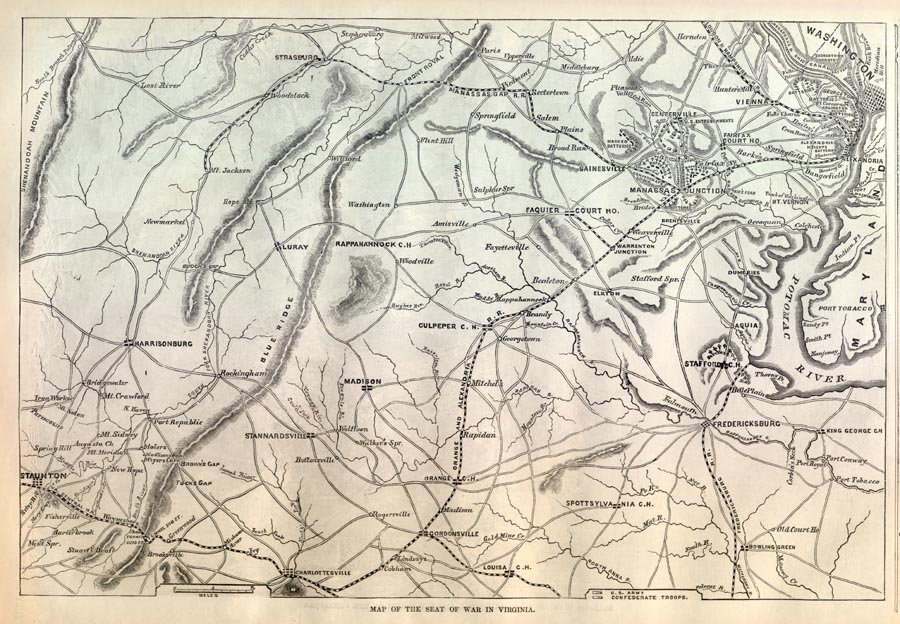
"I intended to have written yesterday so as to wish you a Happy New Years on that day. But business is increasing in the office and then the command of the Regiment on my hands during a week has closely occupied my time. There is nothing worthy of note occurred within a few days. Col. Veazey has improved and is now out with the regiment on picket. Major Rounds is also out." ~ Lt. Col. Charles Cummings, Sixteenth Regiment, Letter No. 14, January 2, 1863. VHS.
"Centerville, Va., Jan. 2d, 1863.
"Dear Sisters: When I wrote the other day, we were in a hubbub; said hubbub has now subsided, the rebels having, apparently, done the same. All the damage I have heard of doing, was an attempt to burn a railroad bridge, the cutting of the telegraph wire, and the supposed extraction of messages at Burke's station.
"We relieved the 15th at this place, yesterday. The first time we came out on picket, we went beyond here, but the line has been drawn in. The 15th was obliged to fall back, and occupy the earth-works at this place, during the "raid," but were not attacked.
"I wish you could paint a picture of Centerville. Imagine how the village of Brattleboro would look after having been lifted 5000 feet into the air by a whirlwind, and suddenly dropped "ker-smash"! There are a few houses standing, perhaps a dozen in all, and a few inhabitants; but the ruins of a church, mill, &c., show that it is not what it once was, and it is not easy to see how it ever will be.
"... Here, on picket, we make our own coffee, and fry our hard bread in pork fat. Uncle Sam's stock of old wormy crackers, which had, apparently, been kept over from the war of 1812, are about exhausted, and we now have fresh ones, whose only bad effect is, that they make a man hungry. ..." ~ Daniel B Stedman Brattleboro, VT, age 22, Pvt., 16th Regt, Co. B, Letter of January 2, 1863 Brattleborohistory.com
"Who is this that looks forth like the dawn, fair as the moon, bright as the sun, terrible as an army with banners?"
Wednesday, January 2, 2013
Tuesday, January 1, 2013
Thursday, January 1, 1863. Picket Duty
January 1. The Sixteenth takes its turn on picket at Centreville.
Monday, December 31, 2012
December 31, 1862. Resignations
![]() |
| George Clark Sgt. Co. E promoted 2d Lieut Co. D 16th Regt. 12/31/1862 |
"Wed. Eve Dec. 31st ...Three of the resignations in our Regt have been accepted. The Capt & 2d Lieut of Co. H. (Felchville) & Lieut Sherwin of Co. D. (Townsend) There are 4 more which will doubtless be accepted before long. I think Geo Clark stands quite a chance for a Lieutenancy. I would not take a Captaincy (not that there is any propect of my getting one) on any account. I consider a 1st Lieutenancy altogether better.
"This is the last letter I shall write in 1862 Tomorrow another year begins I wonder if it is to be a year of so much suffering as '62 has been.
"We have got a splendid Gen. & the Gen has a splendid staff. The whole Brigade are very much pleased with him." ~ Joseph Spafford, 1st Lieutenant, Company E, Sixteenth Regiment, Letter, December 30 1862, UVM
"Dec. 31. All are mustered. The boys do their best, at washing themselves and clothes, cutting hair and scouring guns, to show off as well as they can. The brigade head-quarters are established at the village, and for the past few days the regiment shave taken turns in sending a hundred men to guard them. No little sensation has been produced by the arrest of several officers and privates, for not dressing, and washing, and stepping, and saluting, and other smaller things, just according to stern military rules. So before leaving our parade ground we go through a mimic guard-mount, under the eye of a field officer. We make a number of mistakes here. These are pointed out. And as is often the case, when, one not thoroughly versed in what he is doing, attempts at being over nice, comes short of his common work, so we under the eye of the General. Yet none are arrested; but some are sworn at, and one of the lieutenants laughed at for making a sort of an awkward start instead of a graceful salute as he passes the officer of the day. Two regiments of cavalry camped near the village. Some of these about midnight make havoc with the sutler's shops, helping themselves to the tobacco, beer, cider and apples, before the guards could reach tem, declaring that they were 'on a bust the last day of the year.'" ~ Lt. Edwin Palmer, 13th Regiment, The Second Brigade: or, Camp Life, By a Volunteer (1864)
Sunday, December 30, 2012
December 30, 1862. Excitement and something to do.
"Camp Near Fairfax C.H. Va
"Tuesday Eve Dec 30th 1862
"It was a beautiful moonlight night & the whole Brigade was out, the 15th on picket at Bull Run the 12th & 13th at Fairfax C.H. or near there & the 14th near there in another direction & we (the 16th) down to Fairfax Station. Each Regt lay on thier arms. We were drawn up in line along side of the Catholic Church which had had all the pews taken out & been used as a hospital, it was empty when we were there so our & some Officers from other Co’s went into it & slept.
"The station is between 2 & 3 miles from the C.H. I slept so soundly that I did not even hear the firing at the C.H. which was done by the 12th 13th & the Battery that was with them. Sometime in the night, I dont know what time, some Co’s of the 12th & 13th which were stationed by some old breast works discovered the Rebel cavalry passing & fired into them with no further results that we know of, than killing one of their horses, & taking one of the men prisoner. The Gen. ordered some shells flung after them from the 6 pound guns which were there, which was done, but to no effect it seems.
"Our Regt stayed down to the station until about 3 P.M. The next day when we came back to camp & have been here undisturbed ever since. It makes me so mad I dont know what to do to think how they can slip round among our troops & not get taken. It seems almost impossible that they could pass right through among so many of us here and recieve no further damage. The prisoner captured states that thier object in doing so is meerly to capture what sutlers stores they can so they are getting hungry. ...
"Tomorrow is the 31st day of December & consiquently “muster day” with us. Day after tomorrow is our time to go on picket again for four days. I like it & had rather do it than to stay in camp. This is good fun to what it is staying back to Alexandria or somewhere else where there is no excitement & nothing to do." ~ Joseph Spafford, 1st Lieutenant, Company E, Sixteenth Regiment, Letter, December 30 1862, UVM
"Dec. 30. All quiet until about dark, when it was reported that Jackson was crossing the Rappahannock in force. Then I had to run with orders to the different regiments to hold themselves in readiness to march at one minutes notice with three days rations in their haversacks. Did not get much time to sleep that night." ~ Diary of Oliver A. Browne, Co. K, 15th Regiment.
"Tomorrow is the 31st day of December & consiquently “muster day” with us. Day after tomorrow is our time to go on picket again for four days. I like it & had rather do it than to stay in camp. This is good fun to what it is staying back to Alexandria or somewhere else where there is no excitement & nothing to do." ~ Joseph Spafford, 1st Lieutenant, Company E, Sixteenth Regiment, Letter, December 30 1862, UVM
"Dec. 30. All quiet until about dark, when it was reported that Jackson was crossing the Rappahannock in force. Then I had to run with orders to the different regiments to hold themselves in readiness to march at one minutes notice with three days rations in their haversacks. Did not get much time to sleep that night." ~ Diary of Oliver A. Browne, Co. K, 15th Regiment.
Saturday, December 29, 2012
December 29, 1862. What happened last night.
"It subsequently appeared that the rebels had dashed through our pickets, made a dash twelve miles inside our lines captured the telegraph operator, substituted one of their own at Burke’s Station only three miles east of us and Stuart was reading all dispatches and having all about our strength at the station as Fairfax and elsewhere. Just as he was leaving he sent an audacious message to Washington and then cut the wire.
"It further appeared that he was intending to divide his force at Burke’s Station and with one half destroy and capture everything at Fairfax Station while with the other he would make a detour to the east and both divisions would meet at Fairfax Court House and complete the job, by capturing general and staff officers. What he learned at Burke’s had him but then unknown to us to change his plans.
"The affair was a trifling one; but as the first actual collision with the enemy it made no little stir in the brigade, and on other accounts it had prominent mention in the newspapers and reports. It had also the effect to inspire officers and men with mutual confidence; for the former, from their young general down, were seen to be firm and cool in the prospect of a sharp encounter; and the men were willing and even eager to fight." ~ 2 G.G. Benedict, Vermont in the Civil War 424
Farnham (of the 12th)'s account of the raid is here.
"It further appeared that he was intending to divide his force at Burke’s Station and with one half destroy and capture everything at Fairfax Station while with the other he would make a detour to the east and both divisions would meet at Fairfax Court House and complete the job, by capturing general and staff officers. What he learned at Burke’s had him but then unknown to us to change his plans.
"I was up looking for him or someone else profiting by his diversion all night; my horse was not unsaddled for 18 hours nor was I out of the saddle two hours in the time. I had my men strongly posted and pickets out in every direction that cavalry could come a mile and a half. I knew that we could give him a warm reception while we could not suffer much loss, as infantry can empty saddles to just so well do find themselves with the bayonet that cavalry cannot do much with them. But they let us alone and I missed a grand opportunity for an advantageous scrimmage. I had received orders to hold the post at all hazard and we could all of us them have down it against 5,000 cavalry.
"Stuart foiled in this swept around to the east and came dashing up the Alexandria and Fairfax Courthouse pike to within a mile and a half of the village. But here he found a regiment of infantry on each side of the road concealed in old rifle pits and 2 cannon and a like number of howitzers in the road. He got one volley from two companies of infantry and half a dozen shells which probably killed nobody except a horse, yet blood was distinctly visible in some spots in large pools in a great many places. Quite a number of men must have been severely wounded. Stuart beat a hasty retreat and swept around to the north of the place towards Vienna and Chantilly ...Both Stuart and Lee are natives of this county, several of their soldiers are from this town.
"Col. D’Utassy, who is with a brigade at Union Mills, came down this morning to render assistance, but finding none needed went back. One of our regiments is out all the time, each four days in succession picketing near Centerville about two miles on Bull Run. D’Utassy is below and Sir Percy Wyndham is above at Chantilly (where Israel was captured.)
"Finding all present danger of attack over, I was ordered back this afternoon. I arrived in camp sleepy enough and if this letter is stupid, you will ascribe it to my first preparation for an engagement.
"By the way, Stuart captured Liet. Cummings of Co. D, Vermont cavalry from Barnet. In return he lost several of his own men as prisoners one of whom I send to the provost Marshall at Washington in the morning.
"Heath excellent, and spirits good. You need feel no apprehension about my needlessly exposing myself but I will never come back with reputation of cowardice that some of the Colonels of the Vermont regiments have in the army.
"Veazey is getting better so the major: bilious attack of week’s duration is what’s the matter.” ~ Lt. Col. Charles Cummings, Sixteenth Regiment, Letter No. 13, December 29, 1862. VHS.
"One special object of this raid was, no doubt, to capture the Government stores at Fairfax Station, and in this respect it was a most signal failure. He did not succeed in capturing or destroying a dollar's worth of Government property, except what the 20 cavalrymen captured by him had with them, and all he obtained was a few sutlers' teams. These, however, were just from Washington, and were well loaded with all kinds of delicacies. The wagons were burned on the road near Occoquan, and the contents were disposed of by the rebel soldiers on the spot. A man who passed over the little pike road this morning, says he saw a fine assortment of old boots and empty bottles lining the roadside for miles." ~ Letter from Dumfries,NYT, December 29, 1862
"Stuart foiled in this swept around to the east and came dashing up the Alexandria and Fairfax Courthouse pike to within a mile and a half of the village. But here he found a regiment of infantry on each side of the road concealed in old rifle pits and 2 cannon and a like number of howitzers in the road. He got one volley from two companies of infantry and half a dozen shells which probably killed nobody except a horse, yet blood was distinctly visible in some spots in large pools in a great many places. Quite a number of men must have been severely wounded. Stuart beat a hasty retreat and swept around to the north of the place towards Vienna and Chantilly ...Both Stuart and Lee are natives of this county, several of their soldiers are from this town.
"Col. D’Utassy, who is with a brigade at Union Mills, came down this morning to render assistance, but finding none needed went back. One of our regiments is out all the time, each four days in succession picketing near Centerville about two miles on Bull Run. D’Utassy is below and Sir Percy Wyndham is above at Chantilly (where Israel was captured.)
"Finding all present danger of attack over, I was ordered back this afternoon. I arrived in camp sleepy enough and if this letter is stupid, you will ascribe it to my first preparation for an engagement.
"By the way, Stuart captured Liet. Cummings of Co. D, Vermont cavalry from Barnet. In return he lost several of his own men as prisoners one of whom I send to the provost Marshall at Washington in the morning.
"Heath excellent, and spirits good. You need feel no apprehension about my needlessly exposing myself but I will never come back with reputation of cowardice that some of the Colonels of the Vermont regiments have in the army.
"Veazey is getting better so the major: bilious attack of week’s duration is what’s the matter.” ~ Lt. Col. Charles Cummings, Sixteenth Regiment, Letter No. 13, December 29, 1862. VHS.
"One special object of this raid was, no doubt, to capture the Government stores at Fairfax Station, and in this respect it was a most signal failure. He did not succeed in capturing or destroying a dollar's worth of Government property, except what the 20 cavalrymen captured by him had with them, and all he obtained was a few sutlers' teams. These, however, were just from Washington, and were well loaded with all kinds of delicacies. The wagons were burned on the road near Occoquan, and the contents were disposed of by the rebel soldiers on the spot. A man who passed over the little pike road this morning, says he saw a fine assortment of old boots and empty bottles lining the roadside for miles." ~ Letter from Dumfries,NYT, December 29, 1862
"The affair was a trifling one; but as the first actual collision with the enemy it made no little stir in the brigade, and on other accounts it had prominent mention in the newspapers and reports. It had also the effect to inspire officers and men with mutual confidence; for the former, from their young general down, were seen to be firm and cool in the prospect of a sharp encounter; and the men were willing and even eager to fight." ~ 2 G.G. Benedict, Vermont in the Civil War 424
Farnham (of the 12th)'s account of the raid is here.
Friday, December 28, 2012
Sunday, December 28, 1862. The Sixteenth moves to guard stores at Fairfax Station. Stuart repulsed by fire from the Twelfth.
After Christmas, Lee ordered Stuart to conduct a raid north of the Rappahannock River to "penetrate the enemy's rear, ascertain if possible his position & movements, & inflict upon him such damage as circumstances will permit." Aware that a substantial body of Confederate cavalry were behind their lines the Union Army sent additional troops to Fairfax Station and ordered all wagon trains and supplies there for protection. ~ Burke Station Raid
Dec 28th 1862
"... I have had a little ill- turn the past week, did not go out for a day or two, but have got well over it now. We have beautiful weather. The measles have got into my reg’t, shall be a good deal bothered with them probably now. I wish soldiers had attended to the measles in their proper time.
"There was a battle within hearing of us yesterday but we have not yet heard from it. We were got ready to move. I think we shall be sent somewhere soon. I have a very pleasant camp here, but the water is not first rate.
"... We had quite a time here Christmas day, but I was not very well myself. My Reg’t will have to go to Bull Run again next Thursday.
"The rebels are making a raid below us & we are looking for them this way. My Reg’t is down at the rail road station to-night. The is considerable of a movement going on... ."~ Col. Wheelock G. Veazey, Sixteenth Regiment, Letter to Julia, December 28, 1862. UVM Center for Digital Initiatives
" I had posed writing to you Friday but a brigade drill and the necessity of my commanding the regiment as Col. Veazey and Major Rounds were both sick in connection with the pressing duties of the office, deprived me of that pleasure. Then I was sure I could do it Saturday, but orders came from my regiment to hold itself in momentary readiness to be called out kept me from doing it.
"Well Sunday came and at one p.m., I closed the office and took a brief nap intending to write immediately thereafter. But orders again came for the regiment to be in readiness and I was constantly engaged in endeavoring to learn what all the rumors of war meant. I had on my hands three men of the 5th Penn Cavalry, who had been driven in while picketing on the Occoquan twelve miles south of here at 11 am. and being cut off from their camp made their escape.
"They reported that two brigades of rebel cavalry. Stuart’s and Fitzhugh Lee’s and Hampton’s Legion were this side of the Occoquan making a raid in this direction. Other dispatches from couriers and telegraph partially confirmed their statements.
"According at five o’clock I was ordered to march the 16th Regiment with 2 days ration to Fairfax Station 2 1/2 miles south of here. I had previously solicited liberty to go in case the regiment was called out. At 7 o’clock I had the regiment there and two pieces of artillery under my command on the north side of the Alexandria and Manassas railroad which LTC. Hawley of the 3rd Wisconsin held the south side. Probably there is $300,000 worth of stores at the Station consisting of property that the rebels would like to capture or destroy. As near as we could learn there were about 1600 rebel cavalry out. While in the R. R. Depot attending to the dispatches we found that we could get an answer from Alexandria but none from Burke’s Station three miles east of us in that direction.
"The Supt. had a large train ready to start for Alexandria and telegraphed to know if he should move it along. Answer came “yes, immediately” But we prevailed upon him not to send the train as all was not right." ~ Lt. Col. Charles Cummings, Sixteenth Regiment, Letter No. 13, December 29, 1862. VHS.
"My Dear Sister
"... When I last wrote the Capt & Williams were both sick, they have not yet gone on duty but are nearly well again & will return to duty tomorrow, (monday). There is nothing new, nothing interesting to write, but I know you are anxious to hear from us so we write once in about so often. ... The weather is, & has been very pleasant, ever since we left Camp Vermont. The 15th are out to Bull Run now; our turn comes again next thursday. There was 7 commissioned officers in our Regt resigned lately, thier resignations are not yet accepted but doubtless will be.
"Yesterday we recd orders to be ready to march at a moments notice, after an hour or so the order was countermanded so we are still here. ... Gen. Stoughton is here with the Brigade. We live better & cheaper than we did at Alexandria, as we have the Com. Sergt in our mess. ...
"Fairfax C.H. is about as much of a place as Greenbush, not much more, nor near as much as Perkinsville. ...The Capt of K’s resignation is not yet accepted.* I will write no more to night as I am insomething of a hurry just now. Will write again soon." ~ Joseph Spafford, 1st Lieutenant, Company E, Sixteenth Regiment, Letter, December 28 1862, UVM
[* Samuel H. Hutchinson, Norwich, VT, age 36, Captain, Co. K, 16th VT INF, resigned 1/3/63.]
"[W]e received light marching orders to be ready to march at a moment's notice, without knapsacks but taking our blankets and fly tents, and accordingly we started out and marched to Fairfax station where we were wanted to repel an anticipated rebel raid upon that place, ... . After going doom to the Station at about the quickest common time ever put on record, we were stationed in a little grove some 40 or 50 rods in the rear of, and supporting two guns of the 2d Conn. battery, which belongs to our brigade, and were told to make ourselves as comfortable as we could without fires. I lay down under a fly tent With Baldwin and Alfred and with our three blankets made ourselves entirely comfortable, though some of the boys routed up a little after midnight and kept traveling the rest of the night to keep their feet warm." ~ Hezron G. Day, pvt., Company C, Sixteenth Regiment, Letter of January 4, 1863
"About seven in the evening, we were ordered forward at double-quick. We expected to march to the Station, but went in another direction towards Alexandria, and halted about half a mile beyond the Court House. The 16th was sent to the Station.
"Our force consisted of four thousand infantry, a battery of artillery, and a squad of cavalry. The battery was drawn up in line behind breastworks, supported by the 13th and part of the 12th, and the remainder of the 12th and the 14th were sent out by companies to watch the various roads, videttes being sent out ahead in every direction.
"We had been in these positions but a short time, when the enemy's cavalry made their appearance, driving in the pickets, and coming unexpectedly upon two companies of the 12th, upon whom they charged. The two companies fired a volley at them, killing two horses, and capturing another horse and two prisoners. None of our boys were hurt. The squad that charged fell back to where the larger force was stations in the woods, and built fires. Gen. Stoughton sent a flag of truce there, stating the he would like an interview with Gen. Stuart, who replied that he would correspond in the morning. Gen. Stoughton, desiring an immediate interview, ordered a few shells to be thrown among the, which made them "skedaddle, " and they were not seen or heard of again during the night." ~ J. C. Williams, Corporal, Co. B, 14th Regiment, Life in Camp, 60 (1864)
"[T]he companies sent down the turnpike as skirmishers, and by whose fire the course of the rebel cavalry in this direction was checked, were two companies (B and G) of the Twelfth Vermont, Col. BLUNT. The prisoners, some 15 in number, captured from STUART's force by the Vermont cavalry and infantry, state that the troops repulsed was the advance of the rebel column, led by Gen. STUART in person; that their intention was to make a dash on Fairfax Court-House, and that the results of the volley, which so astonished them, were the wounding of fourteen of the rebel cavalrymen, and the killing of three of their horses, which, with their accoutrements and the arms (revolver and carbine) of two of their riders, were found upon the spot." ~ Letter of "G" to the NYT, January 2, 1863
"They reported that two brigades of rebel cavalry. Stuart’s and Fitzhugh Lee’s and Hampton’s Legion were this side of the Occoquan making a raid in this direction. Other dispatches from couriers and telegraph partially confirmed their statements.
"According at five o’clock I was ordered to march the 16th Regiment with 2 days ration to Fairfax Station 2 1/2 miles south of here. I had previously solicited liberty to go in case the regiment was called out. At 7 o’clock I had the regiment there and two pieces of artillery under my command on the north side of the Alexandria and Manassas railroad which LTC. Hawley of the 3rd Wisconsin held the south side. Probably there is $300,000 worth of stores at the Station consisting of property that the rebels would like to capture or destroy. As near as we could learn there were about 1600 rebel cavalry out. While in the R. R. Depot attending to the dispatches we found that we could get an answer from Alexandria but none from Burke’s Station three miles east of us in that direction.
"The Supt. had a large train ready to start for Alexandria and telegraphed to know if he should move it along. Answer came “yes, immediately” But we prevailed upon him not to send the train as all was not right." ~ Lt. Col. Charles Cummings, Sixteenth Regiment, Letter No. 13, December 29, 1862. VHS.
"My Dear Sister
"... When I last wrote the Capt & Williams were both sick, they have not yet gone on duty but are nearly well again & will return to duty tomorrow, (monday). There is nothing new, nothing interesting to write, but I know you are anxious to hear from us so we write once in about so often. ... The weather is, & has been very pleasant, ever since we left Camp Vermont. The 15th are out to Bull Run now; our turn comes again next thursday. There was 7 commissioned officers in our Regt resigned lately, thier resignations are not yet accepted but doubtless will be.
"Yesterday we recd orders to be ready to march at a moments notice, after an hour or so the order was countermanded so we are still here. ... Gen. Stoughton is here with the Brigade. We live better & cheaper than we did at Alexandria, as we have the Com. Sergt in our mess. ...
"Fairfax C.H. is about as much of a place as Greenbush, not much more, nor near as much as Perkinsville. ...The Capt of K’s resignation is not yet accepted.* I will write no more to night as I am insomething of a hurry just now. Will write again soon." ~ Joseph Spafford, 1st Lieutenant, Company E, Sixteenth Regiment, Letter, December 28 1862, UVM
[* Samuel H. Hutchinson, Norwich, VT, age 36, Captain, Co. K, 16th VT INF, resigned 1/3/63.]
"[W]e received light marching orders to be ready to march at a moment's notice, without knapsacks but taking our blankets and fly tents, and accordingly we started out and marched to Fairfax station where we were wanted to repel an anticipated rebel raid upon that place, ... . After going doom to the Station at about the quickest common time ever put on record, we were stationed in a little grove some 40 or 50 rods in the rear of, and supporting two guns of the 2d Conn. battery, which belongs to our brigade, and were told to make ourselves as comfortable as we could without fires. I lay down under a fly tent With Baldwin and Alfred and with our three blankets made ourselves entirely comfortable, though some of the boys routed up a little after midnight and kept traveling the rest of the night to keep their feet warm." ~ Hezron G. Day, pvt., Company C, Sixteenth Regiment, Letter of January 4, 1863
While the Sixteenth is at Fairfax Station, General Stoughton deploys the Brigade along the Alexandria road and waits for Stuart:
"Our force consisted of four thousand infantry, a battery of artillery, and a squad of cavalry. The battery was drawn up in line behind breastworks, supported by the 13th and part of the 12th, and the remainder of the 12th and the 14th were sent out by companies to watch the various roads, videttes being sent out ahead in every direction.
"We had been in these positions but a short time, when the enemy's cavalry made their appearance, driving in the pickets, and coming unexpectedly upon two companies of the 12th, upon whom they charged. The two companies fired a volley at them, killing two horses, and capturing another horse and two prisoners. None of our boys were hurt. The squad that charged fell back to where the larger force was stations in the woods, and built fires. Gen. Stoughton sent a flag of truce there, stating the he would like an interview with Gen. Stuart, who replied that he would correspond in the morning. Gen. Stoughton, desiring an immediate interview, ordered a few shells to be thrown among the, which made them "skedaddle, " and they were not seen or heard of again during the night." ~ J. C. Williams, Corporal, Co. B, 14th Regiment, Life in Camp, 60 (1864)
"[T]he companies sent down the turnpike as skirmishers, and by whose fire the course of the rebel cavalry in this direction was checked, were two companies (B and G) of the Twelfth Vermont, Col. BLUNT. The prisoners, some 15 in number, captured from STUART's force by the Vermont cavalry and infantry, state that the troops repulsed was the advance of the rebel column, led by Gen. STUART in person; that their intention was to make a dash on Fairfax Court-House, and that the results of the volley, which so astonished them, were the wounding of fourteen of the rebel cavalrymen, and the killing of three of their horses, which, with their accoutrements and the arms (revolver and carbine) of two of their riders, were found upon the spot." ~ Letter of "G" to the NYT, January 2, 1863
Thursday, December 27, 2012
Saturday, December 27, 1862. The Sound of Distant Cannon
"Saturday 27th. This forenoon is given to us to prepare for to-morrow's inspection, so we are cleaning everything generally. Battallion drill in P.M. & Dress Parade as usual. Before dress parade, an aid of Gen Stoughton's rode up & we were ordered to be ready to march, with two days rations in haversack, in light marching order, at a moments notice. Before we could get our rations, another came & gave orders to march at once with one day's rations. Before we were quite ready, another aid came & countermanded the last order, & left the matter so that we are liable to march any moment with 2 day's rations." ~ Diary of Horace Barlow, 57, Co. C, 12th Regiment
"Camp near Fairfax Courthouse
"December 27, 1862
"Dear Parents:
"Another week is almost gone and we are still here in the pine woods mentioned in my last and likely to remain there for another week, although we had marching orders for a little while this afternoon: countermanded soon afterward.
"We have no field officers just now, the colonel and major being both sick, and the lieutenant colonel detailed as provost marshal of Fairfax, but managed to get along without them. We have again stockaded our tents, not in as good style as at Camp Vermont but still quite comfortably. We had but one axe to work with and went into the woods one morning, cut our timber, forged for bricks, and that night had a house to sleep in, fire place and all, notwithstanding we had gone out on battalion drill in the afternoon. The weather for the last few days has been very nice indeed, warm and pleasant, so warm that a person could perfectly be comfortable in his shirtsleeves.
"Yesterday we could hear the boom of cannon from the middle of the forenoon until near night, and today the report is that Sigel and Stonewall Jackson had been fighting, the advantage resting with Sigel. This was probably why we were ordered to march, as Gen. Stoughton heard the firing and telegraphed to Washington for instructions, but receiving no answer to his message sent orders to the regiments of his brigade to be ready to move at a moments warning, whichever way circumstances might dictate. But the cannonading finally ceased and our orders were countermanded.
"I suppose that if we remain here we will have to go out beyond Centerville on picket again about the middle of the week, say, Thursday morning and could we but have as good weather as it has been for the last four days I would rather go than not." ~ Hezron G. Day, pvt., Company C, Sixteenth Regiment, Letter of December 27, 1862
"Dec. 27. ... There was a great excitement here this afternoon. All the Regiments were drawn up in line of battle, and the battery took its position, and we waited with the greatest anxiety for the word to march. We were in this position about half an hour when the order was countermanded. The cannonading was at some twenty five miles from here, but was plain and distinct." ~ Diary of Oliver A. Browne, Co. K, 15th Regiment.
"December 27. The Corps commanded by Gen. Slocum is encamped at present at Fairfax Station, three miles from here, and forms a reserve for Burnside. Firing is heard to-day, in the direction of Union Mills, supposed to be an engagement with the enemy. There is a rumor that the rebel Gen. Stuart is in this vicinity, and intends a raid here. The weather is quite comfortable." ~ J. C. Williams, Corporal, Co. B, 14th Regiment, Lifein Camp, 47-48 1864)
"Dec. 27. ... There was a great excitement here this afternoon. All the Regiments were drawn up in line of battle, and the battery took its position, and we waited with the greatest anxiety for the word to march. We were in this position about half an hour when the order was countermanded. The cannonading was at some twenty five miles from here, but was plain and distinct." ~ Diary of Oliver A. Browne, Co. K, 15th Regiment.
"December 27. The Corps commanded by Gen. Slocum is encamped at present at Fairfax Station, three miles from here, and forms a reserve for Burnside. Firing is heard to-day, in the direction of Union Mills, supposed to be an engagement with the enemy. There is a rumor that the rebel Gen. Stuart is in this vicinity, and intends a raid here. The weather is quite comfortable." ~ J. C. Williams, Corporal, Co. B, 14th Regiment, Lifein Camp, 47-48 1864)
Farifax Station
|
![]() |
| Union Mills |
Subscribe to:
Posts (Atom)