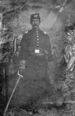
"Our
Reg't won the admiration of all for its gallantry,
having
captured 3 stand of colors and lots of prisoners."
Capt.
E.D.Keyes, Company H, 16th Vt. July 4, 1863
 |
16th Vermont regimental flag
VHS |
Stannard says the
Sixteenth took in "the regimental colors of the Second Florida and Eighth
Virginia Regiments, and the battle- flag of another regiment." ~ Report
of Brig. Gen. George J. Stannard, July 4, 1863.
Veazey's diary says
the third flag was lost: "Captured 3 colors -lost one
afterward. Brought in 2nd Florida and 8th Va. We have won a great
victory." ~ From the Diary of Wheelock G. Veazey, Colonel, 16th
Vermont Regiment.(VHS), in David Cross, Wheelock Veazey, (Rutland Historical
Society, 1995)
The
first flag. Second Florida
The regimental flag of the Second Florida, "a handsome silk flag," was taken by Company K Color-Sergeant Charles D. Brink, "who bore it off from the field with the colors of the Sixteenth", according to Benedict.
This was indeed a beautiful and special banner, with a sunburst design unique to any Confederate regiment, with the inscriptions "Williamsburg" and "Seven Pines" and the motto
“In God is our trust.” The flag had been sewn by the women of Tallahassee from the best silk gathered by Gov. John Milton of that state.

The Second Florida was under Lang on Wilcox' left. The Sixteenth Vermont, having just flanked and routed one of Pickett’s regiments, turned bout, and crashed headlong into the left flank of the Second Florida. In one swoop, the Vermonters captured eighteen of the regiment’s men. Shane M. Turner,
REARGUARD OF THE CONFEDERACY: THE SECOND FLORIDA INFANTRY REGIMENT "Being unsupported... our only safety from utter annihilation was in retreat." Lang reported. "The 2d Florida being on our left, and their color-bearer wounded, they lost their colors and the greater part of their men."
Southern Historical Papers D. M. Pogue was carrying the regimental flag when, “at the moment the Vermonters attacked, a cannonball tore off his left foot. He handed the flag to another man who took just a few steps before being forced to surrender." Shane M. Turner, (citing D. M. Pogue, Letter “April 9, 1906,” United Daughters of the Confederacy Collection, Florida State Archives, Tallahassee, Florida.)
One of Brink's descendants quotes a witness as later writing "Color Sergeant Charles Brink while carrying his own flag in one hand, grasped a rebel flag with the other and demanded its release."
Others had other stories:
Still another source has the Brink flag as the 2d florida captured on July 2dd by Pennsylvanis troops and left behind. John Michael Priest, Stand to It and Give Them Hell. n.8
The
second flag. Eighth Virginia
The flag of the
Eighth Virginia was brought in by Pvt. Piam O. Harris, of Company E.
The Eighth Virginia
served with Garnett's brigade, on Kemper's left, part of Pickett’s Division. About ninety
percent of the Eighth were killed, wounded, or missing in the charge.
Hunton of the Eight later wrote that "only 10 of those who
went in [the charge] responded to the roll call--190 out of 200 were
gone." Bendedict says "In the thickest of the
assault on Pickett's flank, the colors of the Eighth Virginia, of Garnett's
brigade, fell with the fall of the standard bearer, and were captured by
private P. O. Harris of company E of the Sixteenth"
There
are conflicting stories how the regimental flag of the Eight Virginia came into
Vermont hands.
One speculates
that "Some of the men from the [8th Va] regiment may have been
intermingled with those of the 11th & 24th Va. Regiments of Kemper's
Brigade in parrying the flanking movement by Stannard's 13th & 16th
Vermont Regiments." Kathy Georg Harrison & John W.
Busey, Nothing But Glory: Pickett's Division at Gettysburg.
Eugene Schael's
account of the charge of the "Bloody Eighth" agrees that "the
brigades of Kemper, Garnett and Armistead intermingled. In succession, bearers
of the 8th's flag were wounded and killed. When there was no one left to pick
it up, it was captured by the 16th Vermont Infantry." Eugene Scheel'
"30 Gruesome Minutes for 'Bloody Eighth'" The Washington Post
Company Sunday, July 2, 2000
Another source
says, "The color Sgt. of the 8th Virginia Regiment pitched his flag
into the bushes near the Vermont line [spitting]that he would not fight
with that flag in his hands. A Vermonter picked it up where the Color Sgt.
had left it, only to get wounded and drop the colors. Private Piam Harris
(Company E, 16th Vermont) found it & carried it from the
field." John Michael Priest, "Into the Fight -- Pickett's Charge
at Gettysburg.
According to Wert, Private
Harris found the battle-flag of the Eighth Virginia, as "Harris walked
along the wounded and dead Confederates."
Jeffrey D. Wert, Gettysburg Day Three 228,. This is probably speculation
based on the fact the location of the 8th Virginia was north of Kemper.
Or did Company E
itself fight farther to the north? Perhaps Piam and Company E of the 16th were
fighting at the Angle. Company B of the 16th was north of the
Codori house " separated from the regiment's other
pickets," according to Coffin. "It withdrew toward the Clump of
Trees and would fight there." And Benedict has the Sixteenth's
flanking movement extending behind the Virginians as far north as Codori house:
As the left of
the Sixteenth regiment extended beyond the rear line of the enemy, it
undoubtedly prevented the retreat of a large number of them, and many
surrendered to the Sixteenth. Lieutenant Spafford [ of Company E] with a squad
of men brought in a number of Confederates who were scattered among the trees
of the orchard near Codori's house; and still larger numbers threw down their
arms closer to the Union front. ... In the thickest of the assault on Pickett's
flank, the colors of the Eighth Virginia, of Garnett's brigade, fell with the
fall of the standard bearer, and were captured by private P. O. Harris of
company E of the Sixteenth.
.In a letter from. he battlefield daayed July 5 that was auctioned December 6, 2020, Corporel Francis Long of Company E writes, ""We got a lot of prisoners and our Co. got two strand of colors, one Florida and one Virginia.":
When they got in about the right spot, we rose up and gave them a few volleys and then charged on them, and in 3 minutes there was not a Rebel to be seen with a gun in his hand.We got a lot of prisoners and our Co. got two strand of colors, one Florida and one Virginia. We then fell back and got out of the way of the shells as soon as we could, and soon it came on dark and the fighting stopped. I hope I never shall see another such a day as the 3rd of July was.
"In any
event," as Harrison & Busey say, "the 8th VA lost its flag
to the 16th Vermont sometime during the repulse of the attack." Nothing
But Glory: Pickett's Division at Gettysburg.
The
third flag. Fifth Florida?
Stannard's report refers to a third battle lfag of "another regiment." Benedict's letter of July 4th says this " battle flag of another regiment . . .was foolishly thrown away by the sergeant to whom it was given to carry, who pitched it into the bushes, declaring that he could not fight with that flag in his hands . [Army Life in Virginia}
Veazey's formal report confirms that the third flag was stripped from is standard "The result of this charge was a very large number of prisoners, and, in the two movements, three stand of colors, the colors being stripped from one standard. The two brought in were the Second Florida and the Eighth Virginia."
Benedict's later History says the
third battle-flag was taken by W. C. Kingston of company C. "It had been torn, probably by a shell, so that but a portion of the flag
remained on the standard; and, after carrying it a short distance it was thrown
away by Kingston, as it interfered with his use of his musket, and it was subsequently brought in by other troops."
Kingston's obituary says it was the flag of the “17th Alabama regiment." But the 17th Alabama Infantry Regiment was not present at the Battle of Gettysburg and Wilcox' Alabamians ( the 9th, 10th, 11th, and 14th Alabama Infantry Regiments) had already retreated as Veazey's second charge reached Lang's h three Florida regiment. [The flag of the 13th Alabama was captured on July 3rd during the assault on Cemetery Ridge. According to one account 3 flag bearers were shot down while carrying the flag. The flag was returned to the state of Alabama in 1905.]
A more plausible theory is that the third flag is the Florida flag refered to by Corp. Long of Company E. This likely was was only standard of the battle-flag of the 5th Florida, and that the flag itself had been saved when confederate Capt. Junius Taylor tore it from the staff and hit it under his shirt. Only "the staff stripped of its flag [was] turned it over to Veazey." according to Hess [ Pickets charge : the last attack at Gettysburg.] [This source also has the Flag of the Second Florida not captured in battle but “left lying on the ground to be picked up by Veazey's men."] Source do not mention that th third Florida regiment engaed in the batlle, the _ Florida lost its flag that day.
In any case, only two flags were formally turned in. On July
4 "Sergeant "Brink and Private Harris, escorted by company E of
the Sixteenth, marched to General Meade’s headquarters next day and formally
delivered the captured flags to him, and received his thanks, which he
accompanied with praise of the gallant service rendered by Stannard’s
brigade. Benedict, George Grenville. Vermont in the Civil War. Burlington VT: Free Press Association, 1888 CHAPTER XXVI 475
As Veazey says:
"Captured 3 colors - lost one afterward. Brought in 2nd Florida and
8th Va."
The third flag (or a fourth flag) found? EleventhVirginia
“A third flag was captured by a soldier from the 16th Vermont who was subsequently shot; the banner was reportedly picked up by someone from another regiment and not turned in.” (Note 164)
“Note 164. There is no trace of this flag, but several people apparently witnessed the incident. Benedict, Vermont at Gettysburgh, 19-20; Report of Brig. Gen. George Stannard, July 4, 1863, OR, I, 350; Report of Col. W. G. Veazey, OR, I, 1042, and Veazey to Bachelder (undated), Bachelder Papers, I, 62-64. See also Deeds of Valor, 239; George H. Scott, “Vermont at Gettysburgh, Gettysburg Sources (Baltimore: Butternut and Blue, 1986), Vol. 1, 76-80; Board of State Institutions, Soldiers of Florida in the Seminole Indian, Civil and Spanish-American Wars, 1903, 188.”
“The Damned Red Flags of the Rebellion,” The Confederate Battle Flag at Gettysburg, by Richard Rollins; Rank and File Publications; 1997; pages 178-179, page 206.
On January, 31 2021 a large fragment of a confedrate battleflar flag surfaced in private hands and on April 7, 2025 was
sold at auction for $468,000. See reddit comments
here. The flag had a tag that that stated - "Divided by the men of Co. F, 16th Vt. Vols, July 12, 1863 in honor of Lt. Lawton who was mortally wounded in its capture from retreating rebels, battle near Gettysburg, July 3."
It is the flag of the11th Virginia. The 11th Virginia formed the next to last of Kemper's regiment on the right flank of General Pickett’s charge The 11th and the 24th Virginia would have been engulfed by the flanking movement of Stannard's Vermonters.
The 11th Virginia Infantry Regiment on July 3rd suffered about forty percent casualties from artillery and Vermonters flanking counterattack during the charge. Out of 405 soldiers who began the charge, 250 stood for the later roll call, altogether 26 killed, 65 wounded, 42 wounded and captured, and 22 captured. Facebook post
According to Capt. Smith of the 11th Virginia:
Our colors were knocked down several times as we descended the slope on our side. Twice I saw the color-bearer stagger and the next man seize the staff and go ahead; the third time the colors struck the ground as we were still on the down slope . . . H. V. Harris, adjutant of the regiment, rushed to them and seized them, and, I think, carried them to the enemy's works.
(emphasis added}. Capt. Smith says he reached the abandoned Union works and spent twenty minutes there with 300 men before retreating. These these works were "a hasty trench and embankment, and not a stone wall at the point we struck. "
The flag of 11th Virginia Infantry was apparently captured by 2nd Lt. Cyren B. Lawton of Company F of the 16th Vermont Infantry. Lawton died after the battle of wounds suffered while capturing the flag.
Veazey's Report makes special note of Lawton's sacrifice but does not mention the flag:. "I regret to mention as one of the killed Lieutenant Lawton, Company F. He was a young man of great fidelity and bravery, to whom I was much attached. He fell mortally wounded near the close of the battle"
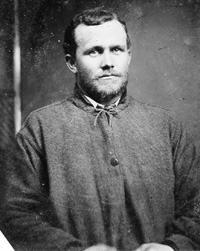
Henry F. Dix (1839 - 1909)
This flag of the 11th Virginia was preserved by Capt. Henry Franklin Dix (1837-1909), of Co. F, 16th Vt. and was then passed down through generations of his family, rather than being turned in to Col. Veazey.
the restored flag with provenance, auctioned in 2025
Postscript
Meade forwarded
the two flags among a large number of captured flags to
Washington.. (" I have the honor herewith to transmit thirty-one
battle-flags, captured from the enemy in the recent battle at
Gettysburgh")
The beautiful silk
flag of the Second Florida, with a record of its capture by the Sixteenth
Vermont, was one of the eighteen captured Confederate flags sent by Secretary
Stanton to be exhibited at the great fair of the Sanitary Commission in
Chicago, in October, 1863. ."The Second Florida
flag is now lost. One source says the War Department loaned it to the 16th
Vermont after the war and it was lost. Another, implausibly, that “the flag
captured that day is now displayed in the State Capitol in Augusta,
Maine." It has somehow .disappeared.
The flag of the 5th Florida was carried off in the shirt of Junius Taylor but its stannard was captured briefly then thrown into the bushes by Sgt Kingston. "The 5th Florida were the only unit in the brigade to not lose their regimental banner in the battle". Waters, Zack C.; Edmonds, James C. (2010). A Small but Spartan Band. . p. 78. The flag carried through the Battle of Gettysburg was reportedly retired in late 1863 and is now in the possession of the Museum of Florida History.
The colorbearer of the 8th Florida fell and its flag was lost during fighting on July 2d. According to The Civil War in the East. the Medal of Honor was awarded to Sergeant Thomas Horan, for extraordinary heroism on 2 July 1863, while serving with Company E, 72d New York Infantry in action at Gettysburg, Pennsylvania, when in a charge of his regiment, he captured the regimental flag of the 8th Florida Infantry But according to the Gettysburg Star and Sentinel published on July 9, 1895, a captain of the 8th Florida had retrurned to the scene and found the 8th's flag buried under the dead bodies of the color guard, every member of which was killed.
The men of Company F kept secret the capture of the 11th Virginia flag and divided it among themselves a souvenir, only to surface 160 years later.