"Who is this that looks forth like the dawn, fair as the moon, bright as the sun, terrible as an army with banners?"
Showing posts with label Stoughton. Show all posts

Saturday, May 11, 2013

May 11, 1863. Picket and guard duty at Union Mills.


Lr. Col. Charles Cummings
16th Vt.
"Camp Near Union Mills, Va. 
"May 11th, 1863 

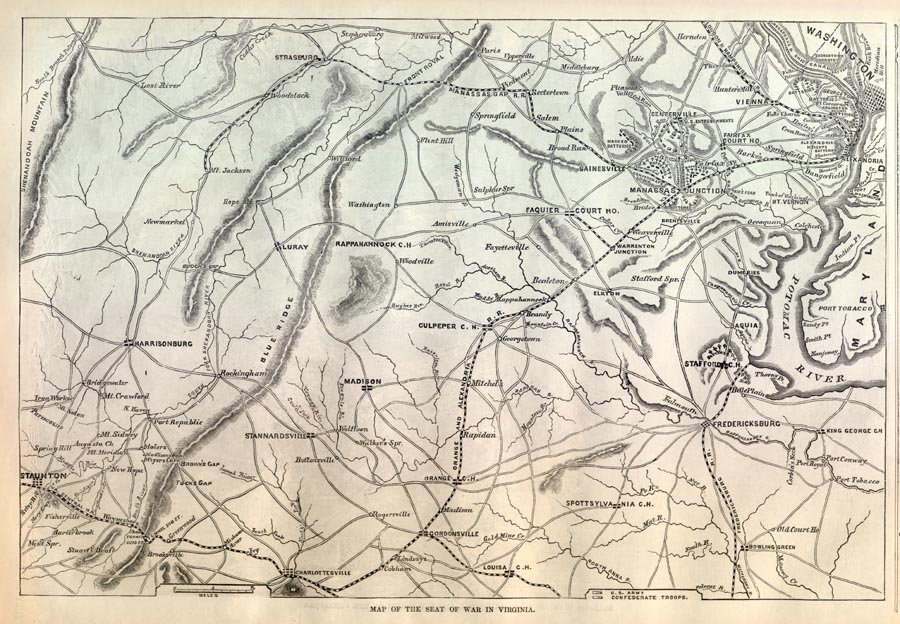
"My Dear Wife,... I should have written you a day or two sooner, but I was on picket Saturday and Sunday. Our brigade is now so scattered that the 16th is the only regiment remaining here, consequently we have all the picketing to do for six miles, and furnish 100 men as a guard at Bristow’s Station, besides sending a guard of 25 men with the train down to the front daily. 

"The 12th is down the Rappahannock at Kelley’s Ford, the 15th at Warrenton Junction a dozen miles this side of the Ford. The 14th at Wolf Run Shoals, and the 13th down on the Occoquan near Occoquan village. 

"We had much rather be down on the front than here, but have to take things as we find them. The reason the 16th was not sent front was, we had the most men fit for duty and it needed a strong regiment to do our work. From present indications it appears as if we should remain here during the remainder of our pilgrimage, as I understand that this picket line is to be maintained for the present.

"The weather is now balmy, warm, and delightful. It is a treat for officers and men to go on picket, both as it relieves the monotony of camp life, and the air is fresh and fragment with blossoms. ...there is a great abundance of wild flowers more beautiful than with us the names of which I have no means of determining. I wish you were here a week to ride out on picket and see what then is beautiful here. But you would find the path you would have to travel anything but slow. It is the worst ground to travel over that I have picketed or seen, but it is easily defensible. Along the bank of Bull Run the ground is intersected by deep precipitous ravines full of laurel, which here grows large and luxuriant and tangled wood.

"Hooker’s attempt, like those of his predecessors, is a failure. It does seem as if the Army of the Potomac was fated to ill-success. Stoneman’s brilliant raid is the only redeeming feature and perhaps we except Sedgwick’s gallant fighting. There was a report in camp last night that Gen. Dix had moved up from Fortress Monroe and taken Richmond, but it is not credited, although it is among the possibilities as there are no rebels about there.

"Gen. Stoughton is in Washington confident of getting the command of the 1st Vermont Brigade. He is making out his official report of his capture. I hope he will get a command for he is above average of the more recent Brigadiers. Gen. Stannard is a capital officer, and a very fine man, and I do not want to change him for any one I know him so well, and he is so reliable. But Stoughton’s assignment to a command would be a good sequel to the unmentioned abuse he has received.

"I have had my head sheared so that there is not a hair on it half an inch long. It is much more comfortable and is easily kept clean. My old horse that I recently bought is picking up fairly and is today worth $100, but poor black is not doing well, he ought to be turned out to grass three months. He is better adapted to a buggy and smooth roads than picketing out here." ~ Lt. Col. Charles Cummings, Sixteenth Regiment, Letters May 11, 1863. VHS.


"May 11th. Hot and warm. Saw Stoneman's cavalry, 20,000, on the road to Falmouth. They were in an open field, marching by division fronts." ~ Diary of Oliver A. Browne, Co. K, 15th Regiment


"Monday 11th. Off duty this A.M. & writing letters & taking it easy. Recd letters from home & feel well, & hearty as a fish in his native element. Weather is getting to be awful hot. Have taken off my underclothing & have to go in short-sleeves, it is so hot." ~ Diary of Horace Barlow (UVM), 118, Horace Barlow, Pvt., Co. C, 12th Regiment


Friday, May 10, 2013

Sunday, May 10, 1863. The 2nd Brigade holds a 50-mile front

Rappahannock Station.

"10th. Went down to Rappahannock station. Met with some Rebs at Kettle Run Bridge. They had fired the bridge and torn up the track. Were at work when we came along but skee-daddled at the sight of the train. We succeeded in saving the bridge and left a guard. When we came back the bridge, about one mile this side, on Cannon Run, was on fire. Just in time to save it. Saw the Rebs, about fifty of Stewart's Cavalry. They intended to capture the train, but found us enough for them." Diary of Oliver A. Browne, Co. K, 15th Regiment


"Sunday 10th. On guard & detailed again as Col's orderly. Had a pleasant time. Day very hot. This A.M. 3 negroes came in & were put in the guard-house, as usual, to await the arrival of the train. About 10 A.M. who should come in but John Minor Botts for the three. One of them was very white & quite intelligent. Of Course, Col Blunt declined to give them up, till he consulted higher authority. I think, personally his feelings & principles would prefer to allow them their freedom, but as it is an important case, as it would establish a precedent, he prefers not to be responsible. I hardly see how they can be given up, after the Presidents' proclamation, but undoubtedly he would receive compensation, in time."Diary of Horace Barlow (UVM), 116-17, Horace Barlow, Pvt., Co. C, 12th Regiment


Bristoe Station.


"Bristow Station, Virginia

"Sunday, May 10, 1863
"Dear Parents

"We are still at Bristow, having been ordered to remain here four days longer than we thought when we first came out here. We have had considerable bad weather since we came, but have enjoyed ourselves very well notwithstanding We are expecting to go back to camp today. The 15th has left its old camp and gone down to Warrenton Junction.

"The fruits of our labor thus far have been 45 or 50 contrabands, one sword, one double barreled shot gun, and one carbine, which we found concealed in the houses of citizens. Also about forty Sesesh fowls, and a lot of hams, meal, etc. The cavalry that was with us has picked up a dozen or so of citizens accused of being sesesh in their proclivities and actions.

"It is as beautiful a Sabbath morning today as ever was; the grass looks green and thrifty, and the apple trees all in bloom. A few of the boys have just gone up the railroad with a hand car for a ride, and are now coming back. They were rather careless, as they had neither arms nor equipment along.

"Since we came here we have seen some good looking white women, the first we have seen since we came into Virginia. From one thoroughly Sesesh widow lady we have taken at least thirty Negroes, found a carbine secreted in one of her beds, etc. We have also in some of our excursions found some good Union people, but those that can be relied on are few in comparison with the whole population. The Unionists are all northern people, mostly from NY or NJ, who have worked their own lands, and have never owned slaves. However, slaves and slavery fast are disappearing from Prince William County. Brentsville, the former county seat, is a little one-horse place so thoroughly Sesesh that there is only four to seven men left there, and unless they are more exemplary in their morals, than most of the people here, they will stand a chance to have their numbers reduced whenever we get in some more cavalry here.

"Stoneman's Cavalry, I presume you have learned, has returned to the Rappahannock. They sent in some thirty prisoners yesterday, including one major, and two or three carloads of contrabands, all smart active young men. 'Tis said that Stoneman has twenty acres of land covered all over with mules, horses and cattle, all standing just as thick as they can be tied, which he brought with him on his return from his recent raid. General Stahl is getting his division all down on the Rappahannock, and it is said that he is going to make another raid while Stoneman takes a rest .

"The weather now is quite hot....We have learned that we are not going to be relieved before tomorrow, and then 'tis thought that the 13th will come out here. We would certainly rather stay here than go back to camp. The boys in camp have drawn all our boards, stovepipes, etc. They would like very well to have us come back and help them do the picket duty, which is coming rather severe on them just now, as there is only one regiment in Union Mills.

"We were deeply disappointed when we learned that Hooker's movement had failed, for we had an abiding faith in the success of this grand movement and even now we have hopes that he has only returned to try it again under what he may consider more favorable auspices.

"I saw Gen. Stahl yesterday. He was on board the cars. Not a very remarkable looking man for a General, though his men say that he is the only man that can take a regiment of cavalry and break a regiment of infantry. The boys are all well and in good spiriting full of fun and frolic, hale and hearty, ready to attack anything from a box of hard tack to a band of bushwhackers. Give my regards to all my friends if I have any, and tell them that we think of coming back to Virginia after the war is over, provided we can get some confiscated land...

"Not long ago the Rebs set fire to a bridge not more than a mile and a half from us but it was put out without damaging the bridge seriously. There are a few bands of these Rebs about here first in one place and then another whom we are not shrewd enough to catch. 

"There is a guard here from Co. "F" now that came down in the cars to guard the train. We need a whole regiment here instead of one company, and if the 13th is coming, I am glad of it. Good bye for now ... H.G. Day" ~ Hezron G. Day, pvt., Company C, Sixteenth Regiment, Letter of May 10, 1863


Camp Widow Violet near Occoquan ferry

"Camp Carusi May 10, 1863 
"Dear Mother

"Gen. Stannard has been on a visit to this regiment and has gone away
today. He stayed till after inspection. We all like his appearance first-rate. He does not appear much like Gen. Stoughton. I hear that he Stoughton has been exchanged and that he is in Washington. All we ask is that they will keep him there and not give him the command of this Brigade again, for we are well suited with the change we have had.


"We have been in this camp one month and nine days, so we begin to think it most time to move. The 12th at Rapahanoc Station and the 15th at Warrington guarding the railroad. We may not move for some time but we have not staid out about so long anywhere, so I think we shall move.

"I am going to Mount Vernon in a day or two if nothing happens. I do not suppose it will do me any good but I want to go. We are so near now and it may be the only chance I shall ever have. It is only 7 miles from here and I can get a pass for two days, so I shall be all right if I go. When next time you write, let me know if you have got my money that I have sent. If you have, do what you are a mind to with it--only have it safe.  ..." 
James Willson, 13th Regt., pvt, Co. B. , Letter #42, March 14, 1863 (VHS)


Thursday, March 21, 2013

Saturday, March 21, 1863; reverberations of Stoughton

"Camp Near Fairfax Station, Va.
"March 21st, 1863

 "…  S. C. Covey in company B, received news, through a telegraph dispatch from the governor to Col. Veazey, last night, that his wife and three children were sick, the former not expected to live. We got him a furlough for fifteen days and he started for Washington this morning to get it approved by Generals Casey and Heintzelman, and if successful, will have Washington and arrive at Brattleboro Monday by the morning train from Springfield. If tomorrow were not Sunday, he would get through from Washington tomorrow night - 23 hours being the regular time between the two cities. He will call upon you before he comes back. He used to peddle meat for Hadley and cut up a pig for us a year or two since. He was detailed as cook for Gen. Stoughton down to the time of the raid, and has since been on similar duty at Col. Blunt’s quarters.  

"Gen. Stoughton has arrived safely at Richmond and is lodged with the other prisoners in the Libby prison. I suspect he will find it uncomfortable quarters in that lousy, filthy den, as his habits and taste for personal neatness and cleanness are of no ordinary order.  I regret that there should be so much bitterness manifested toward him by the city peers and such petty spite and small, low sort of malignity at home. … He is a ladies man, that is he is passionately fond of the society of pretty and chatty young ladies. He was a good tactician and disciplinarian and did much in these respects for the Brigade. But he is far short of being such a genuine soldier as Gen. Phelps. However, he is dead to advancement.  

"I enclosed you slips one giving an account of the general’s arrival at Richmond and the other a copy of Miss Antonia J. Ford’s commission as Major from Gen. Stuart. Miss Ford was always regarded as a respectable woman and member of a highly respectable family. They were all secesh, her brother being in the rebel cavalry Stuart gave a number of such commissions. … Stuart, the Rebel General of Cavalry is only thirty and is fond of just such frolics. …

"I expect Gen. Stannard will be assigned to this brigade, at least it is so understood. He is a plan, practical man with an abundance of good sense, and with that a good soldier. If he comes he will live in his tent like the others of his command, and if he is taken prisoner it will only be after a fight and with the rest of the brigade.  

"I have got my rifle pits nearly completed having made about 3000 yards. Next week I have two or three redoubts to build for artillery and then the defenses for this station will be sufficient for any probable contingency.  

"Lieut. Simonds is not worth much since the reports of his infantry tactics at Brattleboro. He was found drunk in his quarters when wanted for duty the other day, but was let off with a stinging reprimand. Another such offense and he will be court martial and cashiered." ~ Lt. Col. Charles Cummings, Sixteenth Regiment, Letters  March 21, 1863. VHS. 


"Headquarters Second Vt. Brigade,
"Near Wolf Run Shoals, Va.,
"March 21, 1863.

"Dear Free Press: ... Colonel Blunt, as brigade commander, has been making his presence felt at Fairfax Station in the right way. The Station is a point of supply for all the troops at Centreville, Union Mills, Fairfax Court House, Fairfax Station and Wolf Run Shoals. The quantity of quartermaster and commissary stores here, is of course very large -- and the position is to be held at all hazards. It is now, I am happy to say, in a very much better condition for defence than ever before. Rifle pits have been dug and breastworks by the mile thrown up, by the men of the Fourteenth, Fifteenth and Sixteenth regiments, along the high ground surrounding the Station on every side, from behind which they will be happy to meet any force likely to be sent against them. The picket lines have also been closely looked after; the various departments of supply for the brigade have received attention; and the brigade and regimental hospitals have had the benefit of the colonel's occasional unannounced presence and quick eye for defects in management. One learns to value energy and attention to his business in a commanding officer, after seeing how the influence of such qualities is felt throughout down to the last private in the brigade." 
~ Lieut.  G.G. Benedict, Company C, 12th Regiment, Letter to the Free Press of March 21, 1863 in Army Life in Virginia.

Monday, March 18, 2013

March 18, 1863. "The intelligence and enduring virtue of the nation is in the ranks."

"Fairfax Station, VA. March 18th, 1863
E.D. Keyes, Captain Co. H., 16th Regt.

"Mr. Editor – All is quiet at Fairfax. Colonel Stoughton has made a forward movement, - the first of the season. About only a year ago Manassas was taken by a single Yankee, and we sincerely desire that the Colonel may have equal success. Although I do not fancy his style, and presume that he fancies it still less, yet I am a Stoughton man, and of course am ready to whip the first one who says that he is glad the Colonel has been captured; for I consider him a brave and loyal man, and possessed of talents and acquirements equaled by few of his age. No doubt it is considered pure carelessness on his part, and having his headquarters so far from his command. But campaigning in Virginia has proved fatal to most aspirants to military glory upon the sacred soil. Indeed, the commanders who have not made fatal mistakes in this department have been so few, that he can console himself with the fact of belonging to a very numerous class whose names are found in the catalog of blunders which have brought upon us but a series of calamities instead of victories.

"I have heard it talked in camp, many a time during the past few weeks, that Fairfax could be surprised the General and Staff captured, and horses stolen and all be out of our reach before assistance could be rendered. Therefore we were not surprised when the thing was done. But other Generals have made their headquarters at Fairfax, when their commands were at a distance, and no doubt are equally to blame with Col. Stoughton, if any blame attaches to him. The fact is we have been exposed at many points during the past two months. When regiments are scattered over a large space, not within helping distance of each other, rebel cavalry can have it all their own way, when they come in such force as they did two months ago, and the only wonder is that they have not visited us before.

"While the Col. was spending the evening at Fairfax Station with some friends, some ten days before he was captured, a spy visited his headquarters, representing himself as a Federal Captain. The same man was recognized among the rebels at the time of the raid. They crossed our line which is some six or eight miles from the courthouse, with the countersign in some places and others it is presumed they crossed without being noticed by our pickets, who probably on so rainy a night neglected their duty, as is too often the case. On arriving at Fairfax, some of them took off our guard and posted theirs instead, while others went to the quarters of the officers and called them out, a very unmannerly act, to be sure, but they all escaped except Col. Stoughton. Col. Wyndham, commander of cavalry was away in Washington. Col. Johnson of 5th N.Y., escaped out a side window in his nightclothes and crawled under a barn, waiting until the rebels were gone, when he started in pursuit of them with cavalry which had been stationed about two miles from the courthouse, to the number of 200.

"Zimri Messenger of Springfield, Vt., who was acting as orderly at the telegraph office, was taken and placed upon a horse and made to lead five other horses, two of which were the Colonel’s. He made bad work of riding and leading, purposely I presume, and being careless withal, let go of the Colonel’s horses, one of which was found the next day and brought back to the Court House. Finally after riding a couple of miles, he got changed onto a horse which was saddled and having learned that there was a John in the company, and there being a little excitement to the rear, which took the attention of those around him, he started back towards the rear of the column when on being asked, “Who goes there?” he said ,“John,” and that he was going back to help Capt. Moseby who was the leader of the rebels. So he passed on, but soon turned away from the column and scampered for dear life, no doubt displaying horsemanship which would have surprised the rebels who lately had him in charge. During his ride with his captors, he was struck in the back by some weapon which has rendered him unable to do duty, and he is now in the hospital.

"This incident excites quite as much of laughter as indignation. The rebels are smart and they have plenty of opportunities for showing their smartness. And they will continue to play their tricks just so long as we place small forces here and there, surrounded by spies, who can communicate information beyond our lines everyday and the week. And these traitor spies are protected in rights which they do not possess. Their property has been guarded by the Second Vermont Brigade when every bloody rascal of them ought to be driven out of the country. To allow so many spies to remain in the vicinity of Washington is the extreme of folly to say the least.

"Gen. Pope struck a right lead when he ordered traitors to be sent beyond our lines, or suffer a worse fate by remaining. Why we see spies everyday. I would hang them or drive them out of this country, and make Northern Virginia as desolate as the plains of Nebraska. They you will not hear of rebel raids within twenty miles of Washington, when we have thirty thousand federal soldiers within the same distance.

"Signal lights were thrown up from Fairfax the night after the raid, also several times the week previous, by secesh; and the same thing has been done many times during the past winter. Now soldiers who have brains have no respect for such trifling as this.

"The male residents of Fairfax have been sent to the old Capital Prison at Washington. This is a step in the right direction; but like many other steps in that direction, it comes too late.

"Sometimes I have wondered that our armies have not become demoralized. But now I have greater faith in the Republic than ever. When I witness the patience, the sacrificing devotion of those in the ranks, I exult in the faith that the old flag shall yet again wave over every State of the once United. The brain of the Army is in the ranks, and I might almost say the intelligence and the enduring virtue of the nation is in the ranks, and here is the hope of Liberty. If demoralization exists at all it is among the officers, and ever has been.

There is no position which man can occupy which requires more of sterling integrity, than that of being an officer in an army which is fighting for Liberty. The officer who lacks in natural honesty soon becomes a thief, and he has plenty of opportunities for exercising his propensity, for Uncle Sam has lots of property lying around loose.

"The 14th, 15th and 16th have to-day been digging rifle pits in expectation of a visit from Stonewall.

"We have no politics in the 16th, but to carry on the war until the rebellion is put down. So we watch with some interest the movements of copperheads at home. And for everyone who would hold back one iota of strength from the Army, we lay up curses sufficient to damn a whole community. We fight against rebels upon principle, and have for them some respect, but for the men at home, who sympathize with traitors in arms, there is growing in the Army the most intense hatred. And the Army will cherish that hatred as a duty which they owe to Liberty. We are all desirous that the government should raise more men, so that every step gained cannot be lost. I think if 200,000 more men are brought into the field, that three-fourths of the able bodied men of the 2nd Vermont Brigade will re-enlist.

"I believe that the men of the 16th are well pleased with their officers, and well they may be, for we have been treated first rate. Men who are really sick, are granted all the indulgence that could be asked. The regiment is well drilled and looks clean, with but few exceptions, as when it left Brattleboro. And this I consider a high compliment to both officer and soldier."
~ E. D. Keyes, Captain, Company H. writing as "Duane" to the Bellows Falls Times, published March 20, 1863.


"Camp Near wolf run Shoals Va. [March 18,] 1863 

"Dear Parents ... As we have wrote Several times Since the affair at the courthouse it is unneccesary for me to mention in this letter only that it is considered a most shameful affair here & has we think cost Stoughton his commission as general which by the way he never had received the president sent in his name to the Senate to be confirmed but before they acted upon it he was taken prisoner & the president withdrew his nomination. at least that is the report
...

"The typhoyed pneumonia & typhoyed fever are both raging very high. there having seven died in our regiment within the last sixty two hours one of them was from our company. his name was Roderick R. Williams. he enlisted from windsor, but I understand that his father resides in Cornish, N.H.

"I understand that there is one or two companys in the reg. that do not report but from thirty to forty for duty, & where there Should be 18 Lieutenants there is not but Seven reported for duty.

"There was an order to night calling for one man to vollenteer from each company to enlist into the Second Rhode Island Battery to Serve there until our nine months expire & if the battery is Seperated from the Brigade before that time then they will rejoin their company. 
The one that vollenteered from our company was Fred. P. Mather. they are to report to Col. Blunt on or before the twentyieth of this month

"Col. Blunt still remains in command of the Brigade & he is liked by all of the command." 
Jabez H. Hammond, West Windsor, age 20, Sgt. Co. A, 12th Regt Letter No. 33

Sunday, March 17, 2013

March 17, 1863. A murder? The innocence of Antonia Ford.

"Tuesday. 17th. Went to Washington on business to Gen. Casey's office. Stayed in town all night. Lieut. Graham, of the 16th was murdered between 22nd and 1st Streets for his money." Diary of Oliver A. Browne, Co. K, 15th Regiment

"Camp Near Fairfax Station March 17th, 1863


"I see by the newspaper that the recent capture of Gen. Stoughton is the all absorbing topic of conversation and criticism, and that it provokes all sorts of comment.

"I was pained to see copied from the New York Times a gross charge of dalliance with a woman of easy virtue - a Miss Ford - and that assigned as a reason for his remaining away from the immediate command and his consequent capture made against him. The family of Mrs. Ford - was one of the most respectable in the place and the reputation of Miss Ford - whom I knew but was barely acquainted with, was a fair and unspotted as that of any lady in Virginia. 

"Although the General made his quarters at the home about a month, he could have seen but little of her as he boarded in his mess and his apartment were taken care of by an old Negro wench. His mother and sisters occupied the same apartments but took their meals with him at his quarters in a house a square distant.

"Gen. S. is a handsome man is young and fond of female society, but he never had the reputation nor does any officer in this brigade believe him capable of “conduct unbecoming an officer and a gentleman.”

"His military standing and reputation is however, much injured, and his promotion to a brigadier will never receive the sanction of the senate. The president has withdrawn his name for that office. Gen. Stannard will probably he assigned to his brigade."
~ Lt. Col. Charles Cummings, Sixteenth Regiment, Letter  March 17, 1863. VHS. 

Monday, March 11, 2013

March 11, 1863. Good Riddance to Gen. Stoughton

Brig. Gen. Edwin Stoughton
of Chester
"Fairfax Station, Virginia, March 11, 1863
"Dear Parents,

"As I have a few leisure moments, and as there is something to write about, here goes. Brig. Gen. Stoughton has left for the front where he has so long been trying to get us, and the brigade seems to rejoice in his departure, though it seems rather "riled" at the idea of the Rebs being able to dash in to Fairfax Courthouse and get out again unthrashed.... It was curious to hear the comment in camp on receipt of the news! All were somewhat indignant that the Rebs should be so successful in their dash, but their care was not for Stoughton. 


"He had five men detailed from the various regiments for guards, and you could hear the boys inquiring anxiously after they, and making such remarks as, 'Well, I wonder if Old Stoughton feels like cutting anybody's D--d head off now? How much will it reduce the price of whiskey?" "Old Stought has started for the front now. There'll be whiskey enough now so that the men can have some every day," etc. etc., While it is said the 14th almost burst into a cheer when they heard he was gone. 

"I don't think anybody sympathizes with him much, because he had no particular business to be off there three or four miles from his own headquarters, which are at the Station, and from all his command, and remain there week after week. Let him R.I.P."Col. Asa E. Blunt is now in command of the brigade. He is much liked by his own boys, and I guess by the rest of the brigade.

"...Our family are all doing well: Alfred writing, Moses standing by the door smoking a cigarette he made by rolling a little tobacco in a corn husk, and all as contented as clowns, while the other family that lives here, viz Surry M. Ross, is eating a hard cracker, and the boys in the opposite shanty singing songs. The hatchet we use to split hardtacks is badly nicked out on the edge. You can form your own conclusions as to whether the tacks did it or not. H.G. Day" ~ Hezron G. Day, pvt., Company C, Sixteenth Regiment, Letter of March 11, 1863 


"Camp Near Wolf run Va. March 11th 1863

"Dear Father Mother Brothers and Sister one and all. .... You have with out doubt got the particulars of his capture before this time so the most that I have to say is that it a little coolest thing that has ever happened in what war the capturing of a Brigadier General & 18 armed men without a gun being fired upon either side is something that does not happen every day.

"In my last letter I stated that the report was that they captured the members of the Brass band, but the report was untrue. They were withing forty rods of the Gens. quarters yet they were not molested. Neither did they molest the hospital.

"The Regiment is very unhealthy with the camp & typhoyed fever there is one case in our company that is rather doubtful his name R R Williams* typhoyed fever. George Parker is about the same as he has been he has got a slow fever but is not terrible Sick.

"... I do not believe that you can read this for I have been a washing this afternoon & my hand trembles very bad. either caused by that or poor rum. Tell Elwyn that I will write to him just as quick as I can get time & my nerves get steady enough. please to write soon.

"Sergt. J.H.H. to the folks at home" 
 Jabez H. Hammond, West Windsor, age 20, Sgt. Co. A, 12th Regt Letter No. 31

*, Roderic R.Williams, age 24,  Windsor, VT,  Pvt, Co. A, 12th Vt Regt. died 3/14/63


"Head Qrs 16th Vt Camp at Fairfax Station
March 12th, 1863
My Darling Wife,

"I am worried to death about you, have not heard from you for almost a week. What can be the matter. Should thought you would have written if you were not well. I cant write at all myself until I hear from you. Am afraid something has happened to you. I do hope I will get a letter to- morrow. I expect I have lost the oysters on the election, from the news to day. did you get those letters about the money. I first wrote that I wanted you to send some & then countermanded the order. It rains about all the time here now. I am well.

"General Stoughton has sent a letter back to his Mother. He has failed to be confirmed by this mishap. He would have been confirmed Monday the day after he was taken, but his name was withdrawn by the President. Col. Stanard of the 9th will get it probably. Col. Blunt is trying for it. . . .

Yr. fond husband Wheelock ~Wheelock G. Veazey to Julia A. Veazey UVM


Monday, December 31, 2012

December 31, 1862. Resignations

George Clark
Sgt. Co. E
promoted 2d Lieut Co. D
16th Regt.
12/31/1862
"Wed. Eve Dec. 31st ...Three of the resignations in our Regt have been accepted. The Capt & 2d Lieut of Co. H. (Felchville) & Lieut Sherwin of Co. D. (Townsend) There are 4 more which will doubtless be accepted before long. I think Geo Clark stands quite a chance for a Lieutenancy. I would not take a Captaincy (not that there is any propect of my getting one) on any account. I consider a 1st Lieutenancy altogether better.

"This is the last letter I shall write in 1862 Tomorrow another year begins I wonder if it is to be a year of so much suffering as '62 has been.

"We have got a splendid Gen. & the Gen has a splendid staff. The whole Brigade are very much pleased with him." Joseph Spafford, 1st Lieutenant, Company E, Sixteenth Regiment, Letter, December 30 1862, UVM


"Dec. 31. All are mustered. The boys do their best, at washing themselves and clothes, cutting hair and scouring guns, to show off as well as they can. The brigade head-quarters are established at the village, and for the past few days the regiment shave taken turns in sending a hundred men to guard them. No little sensation has been produced by the arrest of several officers and privates, for not dressing, and washing, and stepping, and saluting, and other smaller things, just according to stern military rules. So before leaving our parade ground we go through a mimic guard-mount, under the eye of a field officer. We make a number of mistakes here. These are pointed out. And as is often the case, when, one not thoroughly versed in what he is doing, attempts at being over nice, comes short of his common work, so we under the eye of the General. Yet none are arrested; but some are sworn at, and one of the lieutenants laughed at for making a sort of an awkward start instead of a graceful salute as he passes the officer of the day. Two regiments of cavalry camped near the village. Some of these about midnight make havoc with the sutler's shops, helping themselves to the tobacco, beer, cider and apples, before the guards could reach tem, declaring that they were 'on a bust the last day of the year.'" ~ Lt. Edwin Palmer, 13th Regiment,  The Second Brigade: or, Camp Life, By a Volunteer (1864) 

Thursday, December 27, 2012

Saturday, December 27, 1862. The Sound of Distant Cannon

"Saturday 27th. This forenoon is given to us to prepare for to-morrow's inspection, so we are cleaning everything generally. Battallion drill in P.M. & Dress Parade as usual. Before dress parade, an aid of Gen Stoughton's rode up & we were ordered to be ready to march, with two days rations in haversack, in light marching order, at a moments notice. Before we could get our rations, another came & gave orders to march at once with one day's rations. Before we were quite ready, another aid came & countermanded the last order, & left the matter so that we are liable to march any moment with 2 day's rations." Diary of Horace Barlow, 57, Co. C, 12th Regiment


"Camp near Fairfax Courthouse
"December 27, 1862

"Dear Parents:

"Another week is almost gone and we are still here in the pine woods mentioned in my last and likely to remain there for another week, although we had marching orders for a little while this afternoon: countermanded soon afterward. 


"We have no field officers just now, the colonel and major being both sick, and the lieutenant colonel detailed as provost marshal of Fairfax, but managed to get along without them. We have again stockaded our tents, not in as good style as at Camp Vermont but still quite comfortably. We had but one axe to work with and went into the woods one morning, cut our timber, forged for bricks, and that night had a house to sleep in, fire place and all, notwithstanding we had gone out on battalion drill in the afternoon. The weather for the last few days has been very nice indeed, warm and pleasant, so warm that a person could perfectly be comfortable in his shirtsleeves.


"Yesterday we could hear the boom of cannon from the middle of the forenoon until near night, and today the report is that Sigel and Stonewall Jackson had been fighting, the advantage resting with Sigel. This was probably why we were ordered to march, as Gen. Stoughton heard the firing and telegraphed to Washington for instructions, but receiving no answer to his message sent orders to the regiments of his brigade to be ready to move at a moments warning, whichever way circumstances might dictate. But the cannonading finally ceased and our orders were countermanded.

 "I suppose that if we remain here we will have to go out beyond Centerville on picket again about the middle of the week, say, Thursday morning and could we but have as good weather as it has been for the last four days I would rather go than not."  ~  Hezron G. Day, pvt., Company C, Sixteenth Regiment, Letter of December 27, 1862


"Dec. 27. ... There was a great excitement here this afternoon. All the Regiments were drawn up in line of battle, and the battery took its position, and we waited with the greatest anxiety for the word to march. We were in this position about half an hour when the order was countermanded. The cannonading was at some twenty five miles from here, but was plain and distinct."  Diary of Oliver A. Browne, Co. K, 15th Regiment.


"December 27. The Corps commanded by Gen. Slocum is encamped at present at Fairfax Station, three miles from here, and forms a reserve for Burnside. Firing is heard to-day, in the direction of Union Mills, supposed to be an engagement with the enemy. There is a rumor that the rebel Gen. Stuart is in this vicinity, and intends a raid here. The weather is quite comfortable." J. C. Williams, Corporal, Co. B, 14th Regiment, Lifein Camp, 47-48 1864)

Farifax Station


Union Mills


Tuesday, December 18, 2012

Thursday, December 18, 1862. Rumors of War.

"The next morning after we marched back here we were ordered out a few miles to a Review before Gen. Stoughton."  E. D. Keyes, 1st Lieutenant, Company H, Sixteenth Regiment, Letter of December 23, 1862

"December 18. To-day our brigade was reviewed by Gen. Stoughton, and would have been a proud, as well as an imposing sight, to any Vermonter to witness the parade of five thousand Green Mountain Boys, headed by the brigade band and five drums corps. We hear that McClellan has assumed command of the army, -- if so, I am afraid the war will never end."  J. C. Williams, Corporal, Co. B, 14th Regiment, Life in Camp, 51 (1864).

"We hear all sorts of rumors in regard to Fridricsburg. one day Burnside is all cut to pieces & retreating, the next, Seigle (spelt wrong I guess by the looks) has gone down with his forces & is 15 miles beyond the city & driving the enemy before him. There is one report that does not change (i.e.) Burnside has lost a great many men. I suppose our old Brigade is there. We could hear the canonading when we were at Bull Run. We hear to day that McClellan is in command again. I for one am glad." ~ Joseph Spafford, 1st Lieutenant, Company E, Sixteenth Regiment, Letter, December 18 1862, UVM


Meanwhile, back at Bull Run:

"Dec 18. ...The Rebel Black-Horse Cavalry took eleven of our pickets at Bull Run Bridge. They were dressed in our style and rode into them singing and whistling. When they had got in completely around us they fired and cried out to them to surrender, which they did without any resistance. Five out of sixteen escaped on foot." Diary of Oliver A. Browne, Co. K, 15th Regiment.

Thursday, December 13, 2012

December 13, 1862. The Sixteenth pushes past Centreville. On picket with the dead.

 "Slept well ... and ... at 8 A.M. we started again for Bull Run where we arrived at 4 P.M.  Through some mistake we were marched in the wrong direction making the distance further, but by the mistakes we had the privilege of seeing the battlefield of Chantilly where Gen. Kearney was killed. 

"We passed Centerville little after noon.  There we saw where some 50 or 60 thousand Rebels sheltered last winter.  It was here that McClellan found those big guns which scared him so last spring.  This place of which we have all read much is about half as large as S. Reading but must have been very strongly fortified.  

"On arriving within 1/2 mile of Bull Run 28 men were to be detailed to go on picket.  The men were tired almost to death.  The Capt. tired out before arriving.  I had command.  I called on them to volunteer to go, instead of compelling them to go.  The number required came forth and I went with them as officer of the picket guard.  

"I posted my men at ten o'clock that night.  The first six at Bull run bridge where so many were killed as the first battle of Bull Run commenced.  I scattered the men along beside that stream for about a mile.  I passed over the ground where the Black Horse Cavalry was cut up so, and lots of places of interest which I will not mention now.  I got off duty the next morning at 8 o'clock.  

"There is now men laying there now partially buried.  Their heads and arms lying out of ground.  It made me feel a little skittish as I passed up and down that stream that night all alone thinking of the events that had transpired." E. D. Keyes, 1st Lieutenant, Company H, Sixteenth Regiment, Letter of December 23, 1862

"We halted for rest on the famous heights of Centerville, so long the stronghold of the Rebs. The position to an unpracticed eye, seems strong indeed, a long slope at last half a mile, crowned with earthworks whose guns could sweep every inch Of the declivity and quite a space beyond. From Centerville we marched about a mile and a half and again halted near the spot where we finally pitched our camp, but by mistake we were marched about a mile and a half further, while the colonel was absent looking for a better camping ground. 250 men were detailed to go on picket and the rest, myself among them, went beak to our last resting place and set up our fly tent, made coffee, roasted salt heavy (?), and made ourselves as comfortable as we could generally." ~  Hezron G. Day, pvt., Company C, Sixteenth Regiment, Letter of December 18, 1862

"[Fairfax Courthouse] December 13th. A very mild and pleasant day. Have been over to all the regiments with orders. The 16th  has gone to Centreville. All the others remain at present. Gen. Slocum has just arrived in town. Called on General Stoughton, took lunch, and cracked a little wine. He is a very impressive man. Wears an old blouse and felt hat and does not look so well as some of the priests. He is going to take quarters in some of the vacant houses, of which there are a great number for so small a place. ... Gen. Slocum’s division passed through this place this afternoon on their way to Frederick. Their artillery and baggage train was five miles long."  Diary of Oliver A. Browne, Co. K, 15th Regiment.

Tuesday, December 11, 2012

Thursday, December 11, 1862. Orders to move out of Camp Vermont

"Thursday 11th. As Gen Stoughton has altered the picket business so that we only stay out one day, our turn comes to-day. On the old right wing. On first relief & so on, from 9½ till 5½. Had a fire & were warm & nice. Got in & was thinking of the beautiful nights sleep, I should have, when, "O! horrors of war"! a messenger came to tell us to withdraw the picket & return to camp as we were ordered to leave at 5 the next morning for parts unknown."  Diary of Horace Barlow, 48-49,  Co. C, 12th Regiment


"[O]n returning from a hard days work on our fort, we were informed that the next morning, at 3 o'clock, we must strike tents, pack up, and leave!" ~ Pvt Daniel B Stedman 16th Regt Co. B, Letter of December 15 1862     Brattleborohistory.com


"Just now one of Gen. Stoughton's aids rides up, and hands the colonel a letter. He reads it; then (as is his custom) begins to bite his mustache, and rub his chin with his forefinger. Immediately it is noised through camp that we are to start on a march at five o'clock the next morning, with two days' rations." ~ Lt. Edwin Palmer, 13th Regiment,  The Second Brigade: or, Camp Life, By a Volunteer (1864)


"Four o'clock in the afternoon. We have received orders to be ready to march in the morning at five o'clock. The true soldier is ever willing to sacrifice his comforts for the good of his country. Just as our preparations to make ourselves comfortable through the winter are about completed, we have received marching orders, so that the result of our labors will be left for the benefit of others."  J. C. Williams, Corporal, Co. B, 14th Regiment, Lifein Camp, 47-48 1864)


[ Charles P. Clark, Halifax, VT, age 19, 4SGT, Co. F, 16th VT INF, died of disease 12/11/62]


["On the 11th , when Burnside moved to the Rappahannock and 
commenced his ill-fated Fredericksburg campaign, Sigel's corps was moved 
forward from Fairfax Court House in order to be within supporting distance, 
and the Second Vermont Brigade was ordered up to the position vacated by 
Sigel." Benedict, 2 Vermont in the Civil War 419 (1888)]